Get Ready for Outdoor Fun

Posted on Good Housekeeping
http://www.goodhousekeeping.com/product-reviews/research-institute/summer-exercise-safety

You’ve found your long lost  hiking boots, put air in your bicycle tires, and washed your dingy sun hat. But before you head out for your active summer vacation, make sure to prime your body for the extra exercise. A little prep work can mean the difference between a successful trip and a sidelining injury.

Take your muscles out of storage

Camping, hiking, and biking are great ways to stay fit with your family. But if you’ve been hibernating all winter, ease back into exercise. I talked to American Council on Exercise (ACE) exercise physiologist Jessica Matthews to get some tips on prepping for outdoor activity. To get ready for long hikes, she suggests alternating walking workouts that focus on endurance (build up to continuously walking at a moderate pace for 30 minutes, then 45 minutes, etc.) with ones that emphasize intensity (alternate walking and jogging or flat and uphill inclines). To get ready for long summer bike rides, slowly add cycling to your workout routine, either on a stationary bike, in an indoor cycling class, or outdoors. Start with a warm-up, and then work up to workouts that also vary in duration and intensity. And don’t forget to stretch when you’re done!

Stay safe in the sun

Outdoor exercise means extra sun exposure — so don’t forget your hat! Never leave home without applying the right sunscreen, and bring the bottle with you for frequent reapplication.

Exercising in high heat can lead to heat exhaustion and heat stroke, which can be life-threatening. So take precautions like limiting activity to cooler parts of the day, wearing loose, light clothing, drinking plenty of fluids, and being careful not to get too overheated. Pay attention to symptoms like heavy sweating, dizziness, fatigue, and nausea, and rest and drink cool water or sports drinks if you experience any of them.

Snack smart

Pack healthier versions of your favorite road-trip snacks to ward off hunger on the drive — and on the trails. Dried fruit and nuts will help keep you fueled up, are easy to bring on hikes and bike trips, and don’t need refrigeration. And don’t forget to bring plenty of H2O!

_ _ _ _ _ _ _ _ _ _ _ _ _ _ _ _

Please check the original article here GoodHouseKeeping.com for there are many other useful ideas!

http://www.goodhousekeeping.com/product-reviews/research-institute/summer-exercise-safety

The Possibility of Super Sorghum

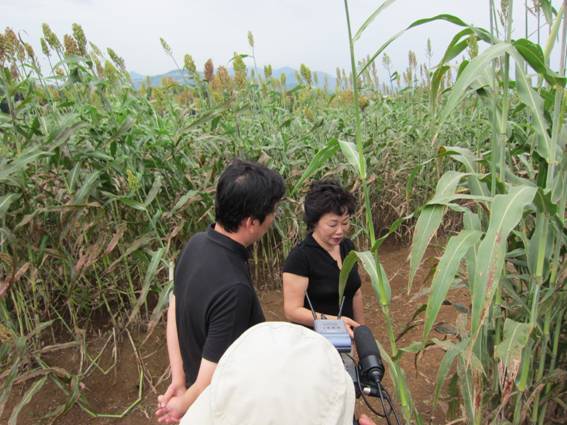
I visited a plant where the bioethanol is produced from super sorghum located in a suburb of Jakarta in Indonesia for making a special TV program.

Syswave Holdings Corp. initiated this project and Mr. Sugiyama gave a tour for us. Amazingly, the main business of this company was IT and nothing related on bio fields until two years ago. They started to cultivate super sorghum in Indonesia from September 2012.  How wonderful their courage and passion for overseas operations is!

By the way, you might be wondering what super sorghum is. Super sorghum is a cultivated plant like a group of sugarcane. This plant can grow rapidly and contain juice having high sugar content. Now, alternatives to petroleum are a pressing issue in the world and each country is taking action for it. Though it’s possible to produce ethanol from crops like corns, other crops as substitution are really needed because of competitive problem with crops for food. Super sorghum comes under the spotlight at such a time.

In 2008, the “Team Sorghum”, a research group consisted of researchers from Tokyo University, Nagoya University and Tokyo University of Agriculture and Technology, was formed in Okinawa and began the research about potentialities of sorghum. Objectives of the sorghum research were to increase the amount of crops, to accelerate the growth of sorghum, and to make it sweeter (15 degree of sugar content) by crossbreeding repeatedly. The team had made efforts continuously until they achieved the ideal ratio of crossbreeding which enabled the plant to increase the lactic acid bacteria after being fermented by itself.

30 types of crossbreeding are conducted in the field owned by Indonesian Institute of Science (LIPI).
Mr. Miyajima, the president of Syswave Holdings Corp., made a collaborative research proposal to LIPI with his motto, “take your chance.” The head of LIPI who had tried to produce alcohol from cassava for five years made a great decision to take this proposal last year.

I am surprised that LIPI entered into MOU (memorandum of understanding) with a nongovernmental enterprise in such a short period. In the similar cases of Japanese government, it usually takes some years to reach an agreement. Now, Tapioca is in boom around the world and tropical drinks and desserts with tapioca gain much popularity. It’s difficult to produce ethanol from Tapioca anymore because the sales price of Tapioca has gone through the roof. However, this situation is good for the sorghum project.

Super sorghum under development by Team Sorghum makes 200kg ethanol production per 2 hectare possible, so the sales price in the market will be very cheap about 50 yen per liter. It shows super sorghum has a great potential to clear conditions as bioethanol.

Super sorghum can be harvested three times in one seeding throughout a year. If you cut the root and just leave it, some sprouts appear and grow up. This easy cultivation is a key to save the cost.

Motorbike is the major means of transportation for the majority of people in Indonesia today. The government supports about 50% of gasoline price and holds the price in 50 yen at the street price, but the burden of this subsidy is very heavy for the government. So, development of cheaper bioethanol is strongly requested as the national objectives.

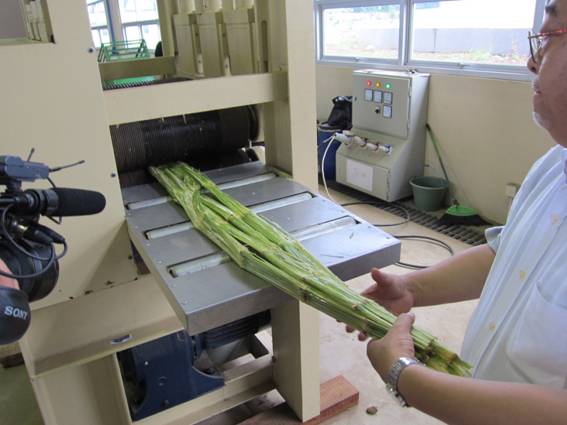
The juice extracting from stalks is very sweet and alcohol is produced by its fermentation in a tank. It’s extracted ethanol by distillation as well as distilled spirit. Extracted ethanol can be mixed in gasoline. This mixed gasoline brings good things such as less pollution and good mileage.

The Institute of Science has now an ambition to establish a complete recycling-based model society in this field. Bagasse is the fibrous matter that remains after sorghum stalks are crushed to extract their juice and contains a lot of mineral and sugar. Compost mixed in fermented bagasse, sorghum leaves and stalks can be used for cultivation of organic vegetables. Also, a dairy farmer can produce delicious beef by feeding diluted fermented bagasse and its manure is good for compost. There are no parts of super sorghum to waste.

If the usage of fermented bagasse and its compost is developed at higher level and is focused attention in the future, super sorghum may grow up more than 6m and be harvested 4 times a year. Now, I expect great success of this sorghum project and I think this is the shortest way that poverty stricken people in the tropical forests can get money. Crop yields per hectare are big with lighter labor. Income source is stable and less dumpling risk because the purchase is assured by the government. This business brings one good thing after another. In fact, many farmers from all parts of Indonesia have already got their hands up for it. I think it’s great.

Omotenashi – The Heart of Japanese Hospitality

Posted on Wonderland Japan WAttention
http://www.wattention.com/archives/omotenashi-the-heart-of-japanese-hospitality/

Do you know what this Japanese word, “Omotenashi” means? I found a great web page for you to get to know Japan well. Please check!
・  ・  ・  ・  ・  ・  ・  ・  ・  ・
WAttention: http://www.wattention.com/archives/omotenashi-the-heart-of-japanese-hospitality/

Revolution in Refuse Disposal in Hot Countries ②

Besides Takakura method and EM technology, there is another pioneer in this field proceeding Sogabe Method. This method is somewhat different from Takakura method in a way to cultivate bacterial strain in a liquid medium like EM technology rather than like EM in liquid. This may be much easier.

The ingredients to make bacterial strain are brown sugar, yeast, yogurt, fermented soybeans (natto). They are let grow under 36 degrees Celsius for 24 hours. The initial liquid medium that EM technology uses are made by combining brown sugar, water, yeast, and lactic acid bacteria (yogurt) with photosynthetic bacteria. The medium is let grow under 35 degrees Celsius for a week. The concentration of bacteria is much higher than Sogabe method, so the liquid medium can be diluted a hundred times.

Either method is overall Japan’s first revolutionary technology using natural, non-harmful microorganisms. They restore rotten and fetid environmental wastes that have increased excessively under the oxidizing environment, water, and oxidized soil. The disposing waste issue around the world eventually creates a frame of pandemic. It is the world’s most important responsibility to secure adequate, healthy food production for the increasing populations. What Takakura method, EM technology, and Sogabe method have in common is that they are all low-tech, but produce significant results, which any local people, even children are able to handle. At the same time, another benefit of those methods and technology is that they successfully led local people to improve their way of thinking toward garbage and environment.


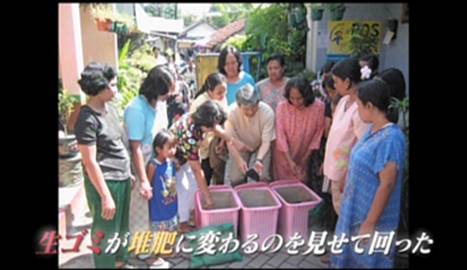
Mr. Takakura traveled around the coutnry
showing how to make kitchen garbage into natural compost.

If the eco-revolution is a topic only among scholars and specialists excluding the general people, it would be impossible to change the way of thinking toward disposing garbage. Also, if it was treated as a means of business, the cost for this activity would have set high as such. The base ingredients with added value are open to public so that they can be prepared easily and reasonably at home, which is another great part of this. What if such technology and methods were developed in the Western societies and the patents were seized all over the world and when the imitations were found, compensation would be charged in the court? The world must have been totally different. I truly believe the developing countries especially the poverty is the severe issue should be assured of good harvest and disposing garbage properly. Agricultural methods using microorganisms are certainly a gift for mankind in 21 century because people engaging with agriculture can be free from liver diseases or cancers. They shall bring about happiness.

Revolution in Refuse Disposal in Hot Countries ①

I had a chance to visit Indonesia for filming a special TV program. Based on this visit, I would like to make a report on eco activities and health issues.

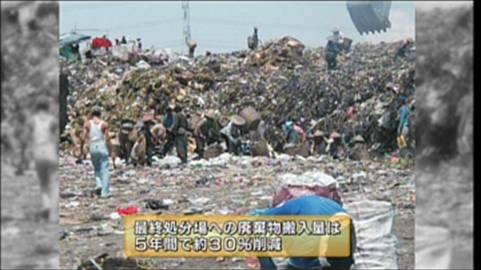
Surabaya, the rural area of Indonesia had a problem of disposing refuse. This is a serious issue common to many other developing countries in tropical areas of the world. One Japanese man named Mr. Takakura faced up squarely to resolve this problem with his idea of ecological compose made from refuse. There is also another person, Dr. Akio Higa in Okinawa, Japan, who developed a world famous ecological technology called EM, Effective Microorganisms. He discovered that microorganisms have potentials to purify soils, water, and even kitchen garbage. Mr. Takakura’s idea is somewhat different from Dr. Higa, but there are several points in common.


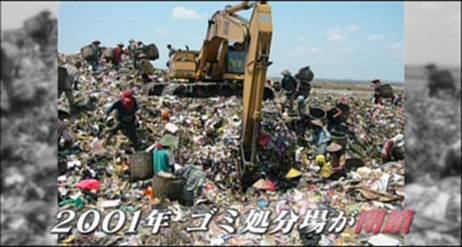
Trash disposal site was closed in 2001.

Mr. Takakura’s original approach is that he did not bring Microorganism strains from Japan but managed to make them locally by mixing leaf mold, rice bran, soybean paste (miso), yogurt, fermented soybeans (natto), and mushrooms. In order to multiply bacteria in number, the strains are settled in a strainer with a newspaper inside for about a week. When the extra moisture is drawn out from the strains, it is ready to mix with the kitchen garbage. The kitchen garbage should be chopped into small pieces for it takes quicker to get fermented.

Takakura method was a huge success that he was able to transform kitchen garbage into compost just in one day in Indonesia thanks to its hot climate. Surabaya used to be a stinking insanitary town with full of refuse and flies all over the town. But as this method has widely spread among nearly17, 000 residents, it has become consequently a significant reformation of the town to clean with full of green and people’s smile.

The most striking feature found in tropical areas is that we can expect to get results quickly. Not only bad bacteria and virus go on a rampage instantly, but countermeasures implemented toward such bacteria can also bring about obvious results to anyone so quickly that can lead to eliminate dissident voice at once.

It was almost 20 years ago when Dr. Higa advocated EM Revolution in Japan. It spread throughout the nation, but at the same time, he received more criticism than applause in a professional field. His colleagues did not agree with some of his statements that EM consisted of 80 kinds of microorganisms. They insisted it was impossible to detect so many microorganisms through a microscope. Only lactic acid bacteria, yeasts, and photosynthetic bacteria were identified. Criticism arose mostly from those who failed to get expected results even though they followed the directions properly. Later on, Dr. Higa rephrased his initial statement that useful microorganisms were not 80 kinds, but the three mentioned above are the main microorganisms

After all, the EM microbial technology has been accepted and appreciated in tropical areas because it achieved a great success in organic farming using compose transformed from refuse. EM technology as well as Takakura method has brought about reliable results enough not only to make the local people impressed but also to prompt the nation’s top leaders to make actions.


Final waste haulage was reduced by 30% in 5 years.

Bali Report – Green School

A school was established in 2008, near Ubud, Bali, Indonesia, built on the ambitious concept of maximizing students’ autonomy and creativity through education in an environment surrounded by nature. It is called the Green School.

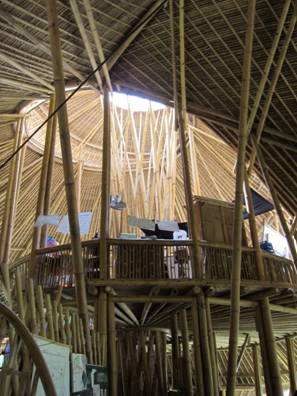
270 students ranging from preschool to high school boys and girls currently attend the school. The unique aspect of this school is that its campus buildings are so artistic, constructed with thick bamboo. The beauty of their ecological setting is overwhelming. The profile of the campus building – two three-story units combined – looks like a pavilion at an ecology and sustainability world expo for which visitors from all over the world would queue. There are no walls or windows in the classrooms so sometimes the direct effects of rain and wind are felt. Additionally, the school has a library and computer room.

The goal of this school is to empower and inspire children of the 21st century so that they have the strength and leadership ability to carry out their responsibilities as citizens of this Earth. In addition to standard academic course contents, students attend such practical works as organic farming, raising farm animals, and making chocolate. In order to promote their relationship with Bali’s local culture, the school offers a scholarship program by which 19 local children are studying in the school as scholarship recipients. I thought that was nice.

Of course, the school’s electrical power is produced by its solar power generator. As there is no wall, you can see the panoramic view in the distance. I saw many children studying in the bamboo classroom with no shoes on, which made me realize they were close to nature. The campus is on 8 hectares of land along the Ayung River. Millennium Bridge, a roofed bridge whose appearance represents Bali, runs across the river and leads to guesthouses.

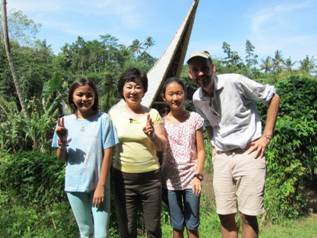
The annual tuition is about 600,000 yen. The fee is considerably less expensive than that of the average international school, which is about 3,600,000 yen, but more expensive than schools in Indonesia. I met and spoke with Green School’s founder Mr. John Hardy. Regarding the school’s concept he said things like, “Families all over the world come to this school, which is still developing. Generally, common schools provide students with a cramming type of education, which makes children’s eyes seem lifeless. Those schools are like jail, where you are treated as an outsider if you don’t do as you are told. You can’t call that education. Here, students work on research of their own making about various themes, and they summarize the results with computers and present the report in front of class members.”

While I was visiting the school, an independent research study on “fish” was taking place, and on the day of the Marine Day Festival, a 12 year-old student made a presentation about how we can increase the population of specific fish species whose numbers are decreasing. In a math class, children in same grade played an online math test practice game. When I saw them having fun studying math, I was impressed that, since they live in the period in which they can access the world via computers, they didn’t fall behind in their high-level academic performance but have overcome the challenge of developing both their individuality and fundamental capabilities.

It’s good to educate children in an ecological environment but it can be a problem when children mature to college age and discover their academic performance insufficient. In Green School, 7 students took college entrance exams and all were accepted by the college of their choice, the results giving the school further confidence.

Meals provided in the school were tasty and free from food additives. I was thrilled by the mere fact that the children were healthy and free of soft drinks and junk food. The school cafeteria was available to adults, serving tasty organic salad with organic bread, which was all really delicious with the ingredients harvested from the school farm. I fully understood why the meals were so delicious. I noticed some Japanese children there, studying in a relaxed way. I thought that people in their situation would come to be able to speak English fluently and become promising youths after graduating from college.

Mount Fuji named World Heritage Site

UNESCO recognizes iconic peak’s cultural influence
http://www.japantimes.co.jp/news/2013/06/23/national/mount-fuji-named-world-heritage-site/

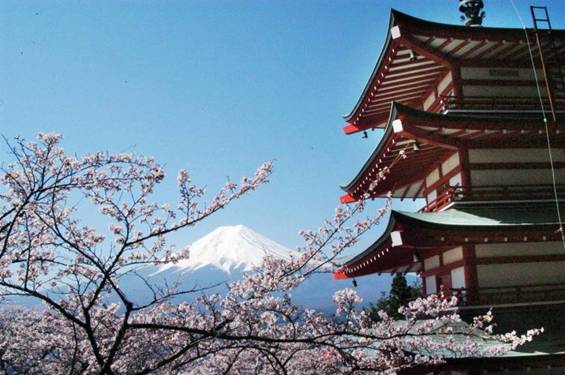
Mountain majesty: Cherry trees are in full bloom outside a five-story pagoda in Sengen Park in Fujiyoshida, Yamanashi Prefecture, at the base of Mount Fuji in 2009. UNESCO decided Saturday to give Japan’s highest mountain World Heritage status. | KYODO

PHNOM PENH – The World Heritage Committee of UNESCO decided Saturday to inscribe Mount Fuji on the U.N. agency’s prestigious World Heritage list.

The 3,776-meter volcano straddling Yamanashi and Shizuoka prefectures was approved by the 21-member panel of the U.N. Educational, Scientific and Cultural Organization during its 37th session in Cambodia’s capital.

Japan’s highest and most celebrated peak was designated a “cultural” rather than “natural” site and registered under the title “Mt. Fuji: Object of Worship, Wellspring of Art.”

It is Japan’s 17th site to make the list and the first since the historic Hiraizumi area in Iwate Prefecture and the Ogasawara Islands in the Pacific won approval in 2011.

Japan asked UNESCO to register Mount Fuji in January 2012 because it has been viewed as a religious site, depicted in ukiyo-e paintings and helped nurture Japan’s unique culture.

Fuji spans roughly 70,000 hectares, including Sengen Shrine at its foot, five major lakes, the Shiraito Falls and the Miho-no-Matsubara pine grove.

In a speech at the session following the inscription, Isao Kiso, a delegate to UNESCO, expressed appreciation for the registration on behalf of the Japanese government, saying he was delighted that the “outstanding universal value of this sacred and beautiful cultural property has been recognized and acknowledged by the World Heritage Committee.”

Shizuoka Gov. Heita Kawakatsu, who also attended, said the inscription “is not the end but only the beginning.”

He said the people of Japan “shall proudly safeguard and pass the legacy of Fuji-san on to future generations.”

Yamanashi Gov. Shomei Yokouchi said it is “a great pleasure” for the people of Japan to hear of Mount Fuji’s inscription.

Chuch Phoeun, secretary of state of the Cambodian Ministry of Culture and Fine Arts, said Mount Fuji “has outstanding universal value and deserves to be listed as such.”

The International Council on Monuments and Sites, the UNESCO panel dubbed ICOMOS, recommended in April that Mount Fuji be listed but without the pine grove, which is a distant 45 km away.

On Saturday, however, the panel had a change of heart.

Residents and officials had earlier attempted to register Mount Fuji as a natural World Heritage site but were thwarted by the illegal dumping of garbage and the fact that the peak lacks global uniqueness as a volcanic mountain.

It was dropped from consideration in 2003.

In 2012, Japan formally asked UNESCO to add Mount Fuji to the list of cultural World Heritage sites in consideration of its religious significance and repeated depictions in works of art.

ICOMOS then recommended Mount Fuji for registration in April, noting that it is a national symbol of Japan, blends religious and artistic traditions, and has an influence that “clearly goes beyond Japan.”
_ _ _ _ _ _ _ _ _ _ _ _ _ _ _
We’ve been longing for this happy news to be announced.
Mt. Fuji has been recognized as Japan’s symbol among the Japanese people.
Now it is official!

Original article: The Japan Times
http://www.japantimes.co.jp/news/2013/06/23/national/mount-fuji-named-world-heritage-site/

Top 10 detox foods

http://www.abs-cbnnews.com/lifestyle/06/02/13/top-10-detox-foods
Posted on 2013/06/02 on ABS CBN news.com
_ _ _ _ _ _ _ _ _ _ _ _ _ _ _
Don’t you ever feel that your body is kind of heavy? Then it must be time to detox. Here is a list of foods that are helpful to detox. It is very important to be attentive what we eat daily because that what makes our body.
_ _ _ _ _ _ _ _ _ _ _ _ _ _ _

10 cleansing foods to get your body back on track.

Recently overindulged? Feeling a bit sluggish? Or just not looking your best? It could be that your body is in need of a detox. Fortunately, there are many foods around that can help counteract the effects of a toxic lifestyle. Whether you want to lose weight, feel more energized, improve your complexion or boost your mood, check out these top 10 foods to cleanse your body and boost your health.

1. Lemon
Lemons are a staple of many detox diets, and there is good reason for this. Firstly, lemons are packed with antioxidant vitamin C, which is great for the skin and for fighting disease-forming free-radicals. Furthermore, the citrus fruit has an alkaline effect on the body, meaning that it can help restore the body’s pH balance, benefitting the immune system. Try starting your day with hot water and a slice of lemon to help flush out toxins and cleanse your system.
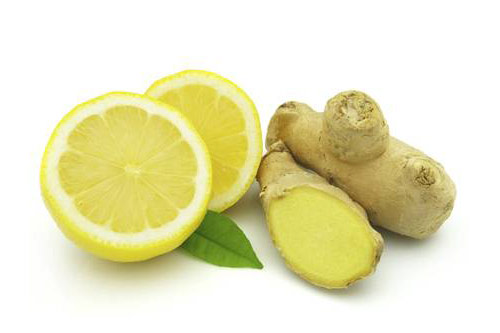
2. Ginger
If too much fatty food or alcohol has caused problems for your digestive system, it may be worthwhile adding some ginger to your diet. Ginger is not only great for reducing feelings of nausea, but it can help improve digestion, beat bloating and reduce gas. In addition to this, ginger is high in antioxidants and is good for boosting the immune system. To give your digestion a helping hand, try sipping on ginger tea or adding some freshly grated ginger to a fruit or vegetable juice.

3. Garlic
Garlic has long been known for its heart benefits, however the pungent food is also good at detoxifying the body. Garlic is not only antiviral, antibacterial and antibiotic, but it contains a chemical called allicin which promotes the production of white blood cells and helps fight against toxins. Garlic is best eaten raw, so add some crushed garlic to a salad dressing to boost its flavour and your health at the same time.

4. Artichoke
If you have recently been overindulging in fatty foods and alcohol, adding some steamed globe artichoke leaves to your meals is a great way to help get your body back on track. Globe artichokes are packed with antioxidants and fiber and can also help the body digest fatty foods. On top of this, globe artichoke is renowned for its ability to stimulate and improve the functions of the liver — the body’s main toxin-fighting tool.

5. Beetroot
For those needing a quick health-boosting shot of nutrients, you can’t do much better than beetroot. Packed with magnesium, iron and vitamin C, the vegetable has recently been hailed as a superfood due to its many reported health benefits. Not only is beetroot great for skin, hair and cholesterol levels, but it can also help support liver detoxification, making it an ultimate detox food. To enjoy its benefits, try adding raw beetroot to salads or sipping on some beetroot juice.

6. Green tea
While it’s not technically a food, no detox plan would be complete without regular consumption of essential liquids. Fluids are essential for keeping our organs healthy and helping to flush toxins from the body, and drinking green tea is a great way of boosting your intake. Green tea is not only a good weight-loss drink, but it is extremely high in antioxidants. Research has also suggested that drinking green tea can protect the liver from diseases including fatty liver disease.

7. Cabbage
Many celebs have resorted to the cabbage soup diet to help lose weight and get in shape quickly before a big event, however cabbage is not only good for weight loss – it is also an excellent detoxifying food. Like most cruciferous vegetables (including broccoli and sprouts), cabbage contains a chemical called sulforaphane, which helps the body fight against toxins. Cabbage also supplies the body with glutathione; an antioxidant that helps improve the detoxifying function of the liver.

8. Fresh fruit
Fresh fruits are high in vitamins, minerals, antioxidants and fiber — and are also low in calories, making them an important part of a detox diet. If you’re after brighter eyes and skin, shinier hair and improved digestion, try boosting your intake of fruit and eating from a wide variety of different kinds. The good news is fruit is easy to add to your diet, so try starting your day with a fresh fruit salad or smoothie and snacking on pieces of fruit throughout the day.

9. Brown rice
If you want to cleanse your system and boost your health, it is a good idea to cut down on processed foods. Instead, try supplementing your diet with healthier whole grains such as brown rice, which is rich in many key detoxifying nutrients including B vitamins, magnesium, manganese and phosphorous. Brown rice is also high in fiber, which is good for cleansing the colon, and rich in selenium, which can help to protect the liver as well as improving the complexion.

10. Watercress
Like most green herbs and vegetables, watercress is an excellent health-booster and detox food. Firstly, watercress leaves are packed with many vital detoxifying nutrients, including several B vitamins, zinc, potassium, vitamin E and vitamin C. Secondly, watercress has natural diuretic properties, which can help to flush toxins out the body. To reap the benefits of this nutritious food, try adding a handful of watercress to salads, soups and sandwiches.

(This article was originally published on realbuzz.com.)

Brain Aging May Depend on Childhood Intelligence

http://healthland.time.com/2013/06/06/brain-aging-may-depend-on-childhood-intelligence/?iid=obinsite
By Maia Szalavitz, posted on TIME, Health & Family


DON BAYLEY / GETTY IMAGES

Older people who stay sharp tend to have a thicker cortex, which is the outermost region of the brain that includes the areas responsible for judgment and complex thought. But while preserving the cortex is important for successful aging, a new study suggests that childhood intelligence — not anything specific done in old age — largely accounts for why some elderly people have more cortical tissue and better cognition.
The study, which was published in Molecular Psychiatry, included nearly 600 Scots born in 1936 who had their IQs tested at age 11 and again at 70. When the participants were 73, they had their brains scanned to measure their cortical thickness. The research found that more than two-thirds of the association between cognitive ability in the elderly and cortical thickness was accounted for by differences in IQ decades earlier in childhood.
“It appears that aging well cognitively is not strictly due to something that one does or does not do in old age but rather, the end point of things that have been going on throughout one’s life,” says lead author Dr. Sherif Karama, an assistant professor of clinical psychiatry at McGill University in Montreal.
The study has critical implications for aging research. If people who fare better cognitively in old age are simply those who’ve been smarter throughout life — and presumably had relatively thicker cortices early on — it’s not a matter of other people losing more cortex. Instead, those people may have had less of it to lose.
“It’s not something that simply happens in old age and determines whether you’ll keep your rank order among people of the same age; it’s rather something that has been going on all your life,” says Karama. “This, to me, is an important point. We tend to view old age as if it’s something completely independent of earlier life history.”
Studies of the elderly rarely include data on childhood intelligence because it is not easy to get — and, of course, IQ tests are a controversial measure — but this research suggests that it may need to be taken into consideration.
Still, the relationship between higher IQ and greater cortical thickness is not well understood. It may be that genetic factors create a thicker cortex initially, but it is also known that brain development is exquisitely dependent upon experience. The more a region is used, the bigger it tends to become. This means that some people may become smarter by simply exercising their brains more throughout life. Perhaps the genes involved in intelligence work by making people want to learn; the act of learning then enlarges the brain. “The possibilities are endless,” says Karama.
The research does imply that attempts to enhance cognition through mental exercise or “brain training” are better started earlier rather than later. “I wouldn’t say that these [later] efforts are necessarily misguided but at this point, the evidence for staving off dementia via these methods is unclear,” says Karama.
The study also supports the idea that smarter people have more “cognitive reserve” that can protect them from some of the intellectual decline that can come with age, although the research did not include people with diagnosable dementia.
But here too it gets complicated. It is not known whether having higher intelligence actually prevents cognitive decline and dementia or merely allows people with those conditions to function better because they can hide the most obvious signs. “Some data does indeed suggest that [higher intelligence] postpones its manifestations,” says Karama.
Depressingly, all of this means we have a long way to go before we can truly understand and prevent cognitive decline and dementia. But recognizing the role played by what happens early in life may help bring that goal closer.

Read more: http://healthland.time.com/2013/06/06/brain-aging-may-depend-on-childhood-intelligence/#ixzz2WpDN0cre