Less exercise, not more calories, responsible for expanding waistlines

Released on EurekAlert! On July 7, 2014
http://www.eurekalert.org/pub_releases/2014-07/ehs-len070714.php

Lack of leisure-time physical activity linked to increased obesity, particularly in young women, reports the American Journal of Medicine

Philadelphia, PA, July 7, 2014 – Sedentary lifestyle and not caloric intake may be to blame for increased obesity in the US, according to a new analysis of data from the National Health and Nutrition Examination Survey (NHANES). A study published in the American Journal of Medicine reveals that in the past 20 years there has been a sharp decrease in physical exercise and an increase in average body mass index (BMI), while caloric intake has remained steady. Investigators theorized that a nationwide drop in leisure-time physical activity, especially among young women, may be responsible for the upward trend in obesity rates.
a1

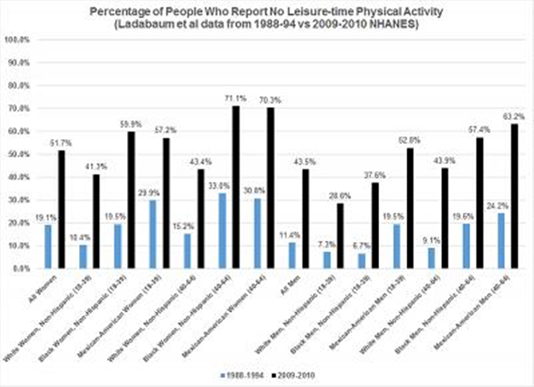
Caption: This graph shows the percentage of people who report no leisure-time physical activity, based on data from the 1988-94 vs. 2009-2010 NHANES.

Credit: The American Journal of Medicine, Ladabaum et al.

By analyzing NHANES data from the last 20 years, researchers from Stanford University discovered that the number of US adult women who reported no physical activity jumped from 19.1% in 1994 to 51.7% in 2010. For men, the number increased from 11.4% in 1994 to 43.5% in 2010. During the period, average BMI has increased across the board, with the most dramatic rise found among young women ages 18-39.

“These changes have occurred in the context of substantial increases in the proportion of adults reporting no leisure-time physical activity, but in the absence of any significant population-level changes in average daily caloric intake,” explains lead investigator Uri Ladabaum, MD, MS, Associate Professor of Medicine (Gastroenterology and Hepatology), Stanford University School of Medicine. “At the population level, we found a significant association between the level of leisure-time physical activity, but not daily caloric intake, and the increases in both BMI and waist circumference.”

The study looked at the escalation of obesity in terms of both exercise and caloric intake. While investigators did not examine what types of foods were consumed, they did observe that total daily calorie, fat, carbohydrate, and protein consumption have not changed significantly over the last 20 years, yet the obesity rate among Americans is continuing to rise.

Researchers also tracked the rise in abdominal obesity, which is an independent indicator of mortality even among people with normal BMIs. Abdominal obesity is defined by waist circumference of 88 cm (34.65 in) or greater for women and 102 cm (40.16 in) or greater for men. Data showed that average waist circumference increased by 0.37% per year for women and 0.27% per year for men. Just like the rise in average BMIs, the group most affected by increased rates of abdominal obesity was women.

“The prevalence of abdominal obesity has increased among normal-weight women and overweight women and men,” observes Dr. Ladabaum. “It remains controversial whether overweight alone increases mortality risk, but the trends in abdominal obesity among the overweight are concerning in light of the risks associated with increased waist circumference independent of BMI.”

When Ladabaum et al grouped respondents to the most recent NHANES survey by race/ethnicity and age, they found that more than 50% of the workforce-aged adults in eight demographic subgroups reported no leisure-time physical activity. The following chart displays the results and highlights the differences between the 1994 survey results and those collected in 2010 (albeit, with slightly different survey methods). According to this data, women, and black and Mexican-American women in particular, showed the greatest decreases in reported exercise.

While increased caloric intake is often blamed for rising rates of obesity, no association between these was found in this study; in contrast, an association was found between the trends over time for lack of physical activity and high BMI numbers. “Our findings do not support the popular notion that the increase of obesity in the United States can be attributed primarily to sustained increase over time in the average daily caloric intake of Americans,” concludes Dr. Ladabaum. “Although the overall trends in obesity in the United States are well appreciated and obesity prevalence may be stabilizing, our analyses highlight troublesome trends in younger adults, in women, and in abdominal obesity prevalence, as well as persistent racial/ethnic disparities.”

There is no easy answer in our ongoing battle against obesity, but identifying the link between the drop in physical activity and increased BMIs, as well as the groups particularly affected, can assist public health officials to develop targeted, effective interventions. In an accompanying commentary Pamela Powers Hannley, MPH, Managing Editor, the American Journal of Medicine, notes, “If we as a country truly want to take control of our health and our health care costs, the Ladabaum et al paper should be our clarion call. From encouraging communities to provide safe places for physical activity to ensuring ample supply of healthy food to empowering Americans to take control of their health, we must launch a concerted comprehensive effort to control obesity.”

Original Article released:
http://www.eurekalert.org/pub_releases/2014-07/ehs-len070714.php

Link Cited on: LINK de DIET
http://www.nutritio.net/linkdediet/news/FMPro?-db=NEWS.fp5&-Format=detail.htm&kibanID=45241&-lay=lay&-Find

What Are Benefits of Eating Watermelon to Lose Belly Fat?

Posted on LIVESTRONG.COM on April 18, 2014 by Jamie Logan
http://www.livestrong.com/article/295676-what-are-benefits-of-eating-watermelon-to-lose-belly-fat/ 

s

In the battle of the belly bulge, food plays a starring role. Rich, fatty, high-calorie and high-sugar foods will obviously cause you to pack on pounds — often around your midsection. Some foods, however, can actually help you lose total body weight, which will help slim your stomach. Look for foods that are high in water and fiber content and low in calories — like watermelon, for example.

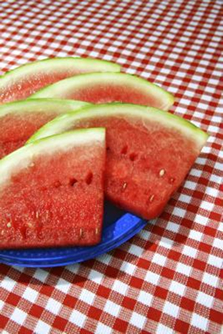
Biting into a big, juicy slice of watermelon can 
help you manage your weight.
Photo Credit Thinkstock/Stockbyte/Getty Images

Weight-Loss Basics

Beating belly bulge is a matter of reducing overall body fat. Everyone loses fat differently, but eventually, if you reduce your total body fat, your stomach will become smaller. The best way to do this is by lowering your calorie intake and increasing your calorie burn through regular exercise. Substituting foods like watermelon in your diet for higher calorie foods like sweets can help you create a calorie deficit. If you create a calorie deficit of 500 to 1,000 calories per day, you could lose about 1 to 2 pounds per week.

Low-Energy-Dense Foods and Weight Loss

Foods that are low in calories per gram should be the focus of a weight-loss diet, suggests the Centers for Disease Control and Prevention. These foods are normally high in fiber or water content, or both. Neither fiber nor water contributes calories, but both help fill you up. This creates a lasting feeling of fullness, which can help you eat less of higher calorie foods so you reduce your total calorie intake and lose weight. Fresh vegetables and fruits, such as watermelon, are the lowest energy-dense foods around because they’re typically highest in fiber and water content.

Watermelon Stats

Watermelon is a little more than 91 percent water by weight. It’s not a very good source of fiber, with only 0.6 gram per cup of diced fruit, which is a normal serving size, but it’s still a very low-energy-dense food with only 0.3 calorie per gram. One 152-gram cup contains only 46 calories. Compare that to one ounce of sour cream-and-onion potato chips that have an energy density of 5.3 calories per gram, or 151 calories total and you can see why snacking on watermelon is a better choice when you have some extra padding to lose around your midsection.

Watermelon in Your Diet

Watermelon will only help you lose belly fat if you eat it instead of other higher calorie foods — and not in addition to those foods. Next time you’re craving something sweet, sink your teeth into a slice of watermelon. You can also get a little more creative with your melon. Make a fresh salad with watermelon chunks, basil and a small amount of feta cheese, or use diced watermelon in a fresh salsa with tomatoes, onions, cilantro and diced green pepper.

Original Article:  LIVESTRONG.COM
http://www.livestrong.com/article/295676-what-are-benefits-of-eating-watermelon-to-lose-belly-fat/

Photoscape / Tiny models a giant boon to small factory

a5Posted on The Japan Times by The Yomiuri Shimbun on June 20, 2014
http://the-japan-news.com/news/article/0001358494

A remarkably accurate miniature kitchen is seen in Arakawa Ward, Tokyo.
Observing the miniature kitchen gives a sensation of being drawn into a miniature world.

By Kunihiko Miura / The Yomiuri Shimbun

A plate of gyoza dumplings smaller than a thumbnail and a glass of beer with a nice frothy head—a Chinese restaurant with these mouthwatering sights has been recreated on a micro level.

These miniature models were produced by Yukio Kawai, 64, who runs a metal stamping factory in Arakawa Ward, Tokyo, where a considerable number of small factories are located. His wife Tomoko, 64, and other family members lend him a helping hand.

The scale model of the Chinese restaurant was ordered by a woman in Kita Ward. She plans to close a Chinese restaurant that her late husband ran, and asked Kawai to recreate it, saying, “I’d like to preserve the restaurant, which is full of memories.”

Kawai took many photos of the restaurant and spent six months making a replica as accurately as he could, even down to the stains on the wall. The woman had tears in her eyes when she received the model.

a6

“It feels like my husband could appear at any time,” she told Kawai.

Miniature dollhouses are extremely common in Europe, and dollhouse-making has become popular in Japan as well, mainly among homemakers. Kawai first started making miniature models when Tomoko, who was attending a dollhouse-making class, asked him to create a miniature pot.

The recreated restaurant kitchen contains a remarkably real-looking sink and cooking utensils, made with a stamping machine capable of processing stainless steel with great precision. Tomoko and other family members are in charge of making miniature food replicas from clay.

a7

Small factories have been struggling as their orders have decreased. Kawai therefore started model production roughly 10 years ago under the name Mini Chuboan (kitchen). Today, model production accounts for 80 percent of the sales at his factory.

Kasahara Spring Seisakusho in Sumida Ward, Tokyo, is another struggling factory that has forged a path forward with a new idea. The company used to produce parts for industrial sewing machines but its workload decreased by half, so fourth-generation company president Katsuyuki Kasahara, 48, developed a business specializing in the production of tongs for serving food.

The company’s castanet-shaped tongs without a handle became a hit for their novel design and user-friendliness. In addition to their popularity in Japan, the product is also displayed in select shops in Paris today.

“I thought I couldn’t allow the company’s business to end during my time as president,” Kasahara said.

Small factories in Tokyo are branching out into new businesses with their wisdom and effort.

Original Article:  The Japan Times by Yomiuri Shimbun
http://the-japan-news.com/news/article/0001358494

14 Healthy Reasons to Eat Kiwi

Posted on Care2 on April 17, 2013 by Diana Herrington
http://www.care2.com/greenliving/14-healthy-reasons-to-eat-kiwi.html

a3

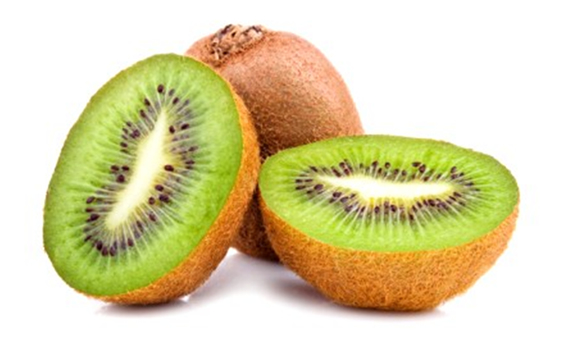
People are attracted to kiwifruit because of its brilliant green color and exotic taste. But, the real uniqueness of kiwi fruit comes from its health benefits. Read the kiwi’s fourteen health benefits, interesting facts, and how to use this amazing powerfood.

14 Health Benefits

1. Helps Your Digestions with Enzymes
Raw kiwi contains actinidain, a protein-dissolving enzyme that can help digest a meal much like the papain in papaya or bromelain in pineapple.

2. Helps Manage Blood Pressure
Kiwi’s high level of potassium helps keep our electrolytes in balance by counteracting the effects of sodium.

3. Protects from DNA Damage
A study by Collins, Horska and Hotten showed that the unique combination of antioxidants in Kiwi fruit helps protect the cell DNA from oxidative damage. Some experts conclude this can help prevent cancer.

4. Boosts Your Immunity
Kiwi’s high vitamin C content along with other antioxidant compounds has been proven to boost the immune system.

5. Smart Carb for Weight Loss
Kiwi’s low glycemic index and high fiber content means it will not create a strong insulin rush like other fruit with high sugar contents — so the body will not respond by storing fat.

6. Improves Digestive Health
Kiwis are a great source of fiber. This prevents constipation and other intestinal problems.

7. Helps Clean Out Toxins
The fuzzy fiber of Kiwi helps bind and move toxins from your intestinal tract.

a4

8. Helps Fight Heart Disease
Eating 2-3 kiwis a day has been shown to reduce the potential of blood clotting by 18% and reduce triglycerides by 15%. Many individuals take aspirin to reduce blood clotting, but this causes many side effects including inflammation and intestinal bleeding. Kiwi fruit has the same anti-clotting benefits with no side effects, just additional health benefits!

9. Suitable For Diabetics
Kiwi is in the ‘low’ category for glycemic index, meaning it does not raise your blood sugar quickly. It has a glycemic load of 4 which means it is safe for diabetics.

10. Protects Against Macular Degeneration and Other Eye Problems
Macular degeneration is the leading cause of vision loss in older adults. A study on over 110,000 men and women showed that eating 3 or more serving of fruit per day decreased macular degeneration by 36%. This is thought to be associated with the kiwi’s high levels of lutein and zeaxanthin — both of which are natural chemicals found in the human eye. Although both fruits and vegetables were studied, this same effect was not shown for vegetables.

11. Create Alkaline Balance
Kiwi is in the ‘most alkaline’ category for fruits, meaning it has a rich supply of minerals to replace the excess of acidic foods most individuals consume. A few of the benefits of a properly acid/alkaline balanced body are: youthful skin, deeper sleep, abundant physical energy, fewer colds, less arthritis, and reduced osteoporosis.

12. Great for the Skin
Kiwis are a good source of vitamin E, an antioxidant known to protect skin from degeneration.

13. Exotic Taste and Look for Food Variety
Kiwis look and taste great. Kids often love them because they are so different from most fruits.
For nutritional balance it is always good to eat a variety of foods. Each food has its own unique qualities and powers. The trouble with most people’s diet is that we eat such a limited number of foods. It increases our chances of not getting enough of important nutrients.

14. Naturally Organic
Kiwi fruit is on the list of foods that are generally safe from a lot of pesticide residues. For 2012 it came in with the top 10 safest foods. While it is always good to support organic when you can as a matter of principle, it’s also good to know whether there is a big danger if organic is not available or viable for you.

Read more: http://www.care2.com/greenliving/14-healthy-reasons-to-eat-kiwi.html#ixzz35dCgB8zT

Fatty liver disease prevented in mice

Washington University in St. Louis, on June 2, 2014
BY Julia Evangelou Strait
https://news.wustl.edu/news/Pages/26989.aspx

a1

Studying mice, researchers have found a way to prevent nonalcoholic fatty liver disease, the most common cause of chronic liver disease worldwide. Blocking a path that delivers dietary fructose to the liver prevented mice from developing the condition, according to investigators at Washington University School of Medicine in St. Louis.

 The study appears in a recent issue of The Journal of Biological Chemistry.

 In people, nonalcoholic fatty liver disease often accompanies obesity, elevated blood sugar, high blood pressure and other markers of metabolic syndrome. Some estimate as many as 1 billion people worldwide have fatty liver disease, though some may not realize it.

 “Fatty liver disease is a major topic of research right now,” said first author Brian J. DeBosch, MD, PhD, clinical fellow in pediatric gastroenterology. “There are competing hypotheses about the origins of metabolic syndrome. One of these hypotheses is that insulin resistance begins to develop in the liver first. The thought is if we can prevent the liver from becoming unhealthy to begin with, maybe we can block the entire process from moving forward.”

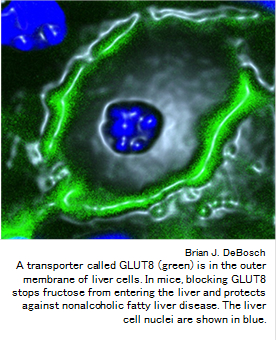
 The research team, led by Kelle H. Moley, MD, the James P. Crane Professor of Obstetrics and Gynecology, showed that a molecule called GLUT8 carries large amounts of fructose into liver cells. Fructose is a type of sugar found in many foods. It is present naturally in fruit and is added to soft drinks and myriad other products in the form of high-fructose corn syrup.

 Scientists have known that fructose is processed in the liver and stored there as fat in the form of triglycerides. In this study, researchers showed that blocking or eliminating GLUT8 in mice reduced the amount of fructose entering the organ and appeared to prevent the development of fatty livers. Mice with GLUT8 deficiency also appeared to burn liver fat at a faster rate than control mice.

 “We showed that GLUT8 is required for fructose to get into the liver,” DeBosch said. “If you take away or block this transporter in mice, they no longer get diet-induced fatty liver disease.”

The researchers also saw differences between male and female mice in the degree to which they were protected from fatty livers and in whole-body metabolism. Male mice fed a high-fructose diet while deficient in GLUT8 still had evidence of fatty liver disease, but whole-body metabolism was healthy. They showed no evidence of metabolic syndrome in the rest of the body. Females fed fructose while lacking GLUT8, in contrast, had healthy looking livers but exhibited more evidence of whole-body metabolic syndrome.

 “If the fructose doesn’t go into the liver, it may go to peripheral tissues,” DeBosch said. “Female mice with a GLUT8 deficiency had increased body fat. They also had increased circulating triglycerides and cholesterol.

 “So the liver is healthier in female rodents, but you could argue that the whole body has worse overall metabolic syndrome,” he said. “This supports the idea of the liver acting as a sort of sink for processing fructose. The liver protects the whole body, but it may do so at its own expense.”

 While DeBosch said future therapeutics might be able to target GLUT8 to block fructose from entering the liver, more work must be done to understand how this would impact the rest of the body.

 “In a perfect world, it would be good if we could figure out a way to direct fructose to tissues in which you’re more likely to burn it than store it, such as in skeletal muscle,” he said.

 In the meantime, DeBosch advises his pediatric patients, many of whom are overweight or obese, to avoid fructose, especially sugar-sweetened drinks, and to find ways to increase physical activity.

  Original Article released:  
Washington University in St. Louis https://news.wustl.edu/news/Pages/26989.aspx 

 Link Cited on: LINK de DIET
http://www.nutritio.net/linkdediet/news/FMPro?-db=NEWS.fp5&-Format=detail.htm&kibanID=44742&-lay=lay&-Find

Sports and energy drink consumption linked with negative behaviors

Released on EurekAlert! On May 6, 2014
http://www.eurekalert.org/pub_releases/2014-05/ehs-sae050114.php

According to a new study in the Journal of Nutrition Education and Behavior

a2

PHILADELPHIA, PA, May 6, 2014 – Weekly consumption of sports drinks and energy drinks among adolescents is significantly associated with higher consumption of other sugar-sweetened beverages, cigarette smoking, and screen media use, according to a study conducted by researchers from the University of Minnesota and Duke University.

The study was undertaken to build understanding of health behavior patterns related to adolescent consumption of sports and energy drinks and inform intervention strategies to reduce consumption of these sugar-sweetened beverages. Although national data have shown a decline in the prevalence of soft drink and fruit drink consumption, sports and energy drink consumption has tripled among adolescents in recent years. The high caffeine content of energy drinks, as well as the high sugar and calorie content of many sports and energy drinks, has drawn much concern from health professionals

Data for the study were gathered from 20 public middle schools and high schools in the Minneapolis-St. Paul metropolitan area of Minnesota as part of the population-based study, Eating and Activity in Teens (EAT 2010). Surveys and anthropometric measures were completed by 2,793 adolescents during the 2009–2010 school year. Mean age of the participants was 14.4 years, participants were equally divided by gender, and 81 percent identified as a racial/ethnic background other than non-Hispanic white.

Among the measured variables in this study were height and weight; consumption frequency for sports drinks, energy drinks, and breakfast; time spent engaged in physical activity, playing video games, and watching television; and smoking status. Although sports drink consumption was linked to higher levels of moderate-to-vigorous physical activity and sport participation, the overall pattern of associations indicated that sports and energy drink consumption should be addressed as part of a clustering of unhealthy behaviors among some adolescents.

Of note, “among boys, weekly sports drink consumption was significantly associated with higher TV viewing; boys who regularly consumed sports drinks spent about one additional hour per week watching TV compared with boys who consumed sports drinks less than once per week,” said lead author Nicole Larson, PhD, MPH, RDN, Division of Epidemiology and Community Health, School of Public Health, University of Minnesota, Minneapolis. As another example, “boys who consumed energy drinks at least weekly spent approximately four additional hours per week playing video games compared to those who consumed energy drinks less than once per week.”

The American Academy of Pediatrics recommends that sports drinks should be consumed by adolescents only after vigorous, prolonged activity, and that energy drinks should not be consumed because they offer no benefit and increase risks for overstimulation of the nervous system. Future research and interventions should target the clustering of related health risk behaviors and pursue more education to promote healthy hydration habits among youth.

 Original Article released:
http://www.eurekalert.org/pub_releases/2014-05/ehs-sae050114.php

 Link Cited on: LINK de DIET
http://www.nutritio.net/linkdediet/news/FMPro?-db=NEWS.fp5&-Format=detail.htm&kibanID=44712&-lay=lay&-Find

Health Benefits of Eating Cucumbers

Last Updated Oct 21, 2013 by Kendra Crawford on LIVESTRONG.COM
http://www.livestrong.com/article/317043-health-benefit-of-eating-cucumbers/

a1
Cucumbers are 96 percent water, but do have valuable nutrients.
Photo Credit Jupiterimages/Photos.com/Getty Images

Because cucumbers are mostly water, they are low in calories — even a large cucumber contains less than 100 calories — but they still come loaded with nutritional value. Eaten either fresh or as a pickle, cucumbers have numerous health benefits, even though they may not be full of flavor. Add them to salads or slice them in spears to eat alone or with a low-fat dip.

Background

Cucumbers are believed to have originated in southern Asia and India more than 10,000 years ago. The many varieties of cucumbers are all part of the Cucurbitaceae family, along with watermelons, zucchini and squash, which are often considered fruits, based on how they are prepared or eaten. Currently, Florida produces more cucumbers than anywhere else in the United States, notes the U.S. Department of Agriculture.

Natural Hydration

Cucumbers are made up of 96 percent water, notes Organicfoods.com.au. Because more than half of the body is made up of water, it is essential for normal functioning of the different systems of the body. A lack of water can lead to dehydration, which can cause fatigue, chills and muscle cramps. Water is crucial for saliva formation and cooling the body through perspiration.

Vitamin C

Cucumbers are loaded with vitamin C. This vitamin serves as one of the many antioxidants that protect the body from free radicals, lowering the risk of various cancers and illness due to damaged cells. Vitamin C has many important functions such as aiding in collagen production and brain function, and it also helps your body process fat.

Vitamin K

Like vitamin A, vitamin K plays a role in building bone, as well as other tissues of the body. However, vitamin K is mainly responsible for making some of the proteins the liver requires for blood clotting. This coagulation ability is important for people who suffer from bleeding disorders, reducing their chances of bleeding out after a cut or injury. Approximately half of the cucumber’s vitamin K content is found in its peel, so keep the peel on for maximal health benefits.

Potassium

A 100g serving, around 3.5oz, of cucumber contains around 150mg of potassium. This mineral aids in metabolic functions and also plays a role in the development of muscle tissue. Adequate potassium is also necessary for maintaining normal electrical activity of the heart, and a diet rich in potassium protects you from high blood pressure.

Original Article:  LIVESTRONG.COM
http://www.livestrong.com/article/317043-health-benefit-of-eating-cucumbers/

Benefits of Sea Salt & Lemon

Last Updated: Aug 16, 2013 | By David Friedman

a5
The combination of lemon and sea salt is rich with antioxidants and electrolytes.
Photo Credit lemons image by Maria Brzostowska from
<a href=’http://www.fotolia.com’>Fotolia.com</a>

Sea salt and lemon are a powerful combination for a variety of reasons. They provide a significant dose of electrolytes, give bland foods a blast of flavor and provide antioxidants to keep you healthy. Many people search high and low to find foods that are both healthful and tasty; sea salt and lemon offer that combination of flavor and nutrients.

Sugar-Free Snacks

Some of us have a sweet tooth, some crave a salty taste and some like both. A salty, lemon-flavored snack can satisfy both of these cravings without simple sugars, which may cause blood glucose fluctuations that can lead to weight gain, diabetes and heart problems. Candies, cookies, pastries and soft drinks are full of calories and sugar with no nutrient value. By getting into the habit of combining sea salt and lemon with healthful foods, you can stanch the need for sugary foods.

Electrolytes

Electrolytes are ionized salts that help your body retain water. A decrease in electrolytes may cause dehydration. Each time you urinate or sweat, you lose electrolytes, so they must be replenished on a regular basis. Most foods you consume contain enough electrolytes to keep you healthy. If you are physically active or you reside in a hot, dry climate, however, you may experience a faster loss of electrolytes. Both sea salt and lemons are great sources of electrolytes.

Nutrients

Lemons are chock-full of the antioxidant vitamin C. Antioxidants fight free radicals in the body, helping to prevent cancer and heart disease. Vitamin C also repairs damaged cells and decreases swelling due to arthritis. Vitamin C may also be an immune-system booster. Sea salt contains significant amounts of common essential minerals such as phosphorus, calcium, copper and potassium. When combined, lemon and sea salt can boost your overall health and well-being.

 Original Article: LIVESTRONG.COM
http://www.livestrong.com/article/267770-benefits-of-sea-salt-lemon/

Nearly one-third of the world’s population is obese or overweight, new data show

Released on EurekAlert! On May 28, 2014
http://www.eurekalert.org/pub_releases/2014-05/ifhm-noo052114.php

No country has successfully reduced obesity rates in 33 years

SEATTLE—Today, 2.1 billion people—nearly 30% of the world’s population—are either obese or overweight, according to a new, first-of-its kind analysis of trend data from 188 countries. The rise in global obesity rates over the last three decades has been substantial and widespread, presenting a major public health epidemic in both the developed and the developing world.

a4The study, “Global, regional, and national prevalence of overweight and obesity in children and adults during 1980-2013: a systematic analysis for the Global Burden of Disease Study 2013,” conducted by the Institute for Health Metrics and Evaluation (IHME) at the University of Washington and published in The Lancet on May 29, found that the number of overweight and obese individuals globally increased from 857 million in 1980 to 2.1 billion in 2013. Overweight is defined as having a Body Mass Index (BMI), or weight-to-height ratio, greater than or equal to 25 and lower than 30, while obesity is defined as having a BMI equal to or greater than 30.

Over the course of the study, rates of overweight and obesity among adults have increased for both men (from 29% to 37%) and women (from 30% to 38%). In developed countries, men had higher rates of overweight and obesity, while women in developing countries exhibited higher rates. Also in developed countries, the peak of obesity rates is moving to younger ages.

“Obesity is an issue affecting people of all ages and incomes, everywhere,” said Dr. Christopher Murray, director of IHME and a co-founder of the Global Burden of Disease (GBD) study. “In the last three decades, not one country has achieved success in reducing obesity rates, and we expect obesity to rise steadily as incomes rise in low- and middle-income countries in particular, unless urgent steps are taken to address this public health crisis.”

Looking at individual countries, the highest proportion of the world’s obese people (13%) live in the United States. China and India together represent 15% of the world’s obese population. Rates in the study were age-standardized, meaning they were adjusted for differences in population size and ages over time and across countries.

Among children and adolescents, obesity has increased substantially worldwide. Between 1980 and 2013, the prevalence of overweight or obese children and adolescents increased by nearly 50%. In 2013, more than 22% of girls and nearly 24% of boys living in developed countries were found to be overweight or obese. Rates are also on the rise among children and adolescents in the developing world, where nearly 13% of boys and more than 13% of girls are overweight or obese. Particularly high rates of child and adolescent obesity were seen in Middle Eastern and North African countries, notably among girls.

“The rise in obesity among children is especially troubling in so many low- and middle-income countries,” said Marie Ng, Assistant Professor of Global Health at IHME and the paper’s lead author. “We know that there are severe downstream health effects from childhood obesity, including cardiovascular disease, diabetes, and many cancers. We need to be thinking now about how to turn this trend around.”

Regionally, countries in the Middle East and North Africa, Central America, and Island nations in the Pacific and Caribbean have already reached exceptionally high rates of overweight and obesity—44% or higher. In 2013, the highest rates of overweight and obesity were seen in the Middle East and North Africa, where more than 58% of men and 65% of women age 20 or older were found to be either overweight or obese. More than two-thirds of the countries in the region had overweight and obesity rates of over 50% in adult men and women. In Central America, more than 57% of adult men and more than 65% of adult women were overweight or obese, with the highest prevalence—greater than 50% among men and women—found in Colombia, Costa Rica, and Mexico. In the Pacific Islands, nearly 44% of men and more than 51% of women are overweight or obese, as are nearly 38% of men and more than 50% of women in the Caribbean.

While the percentage of people who are either overweight or obese has risen substantially over the last 30 years, there have been marked variations across regions and countries. In developed countries, increases in obesity that began in the 1980s and accelerated from 1992 to 2002 have slowed since 2006. Conversely, in developing countries, where almost two-thirds of the world’s obese people currently live, increases are likely to continue.

Key findings:

  • More than 50% of the world’s 671 million obese live in 10 countries (ranked beginning with the countries with the most obese people): US, China, India, Russia, Brazil, Mexico, Egypt, Germany, Pakistan, and Indonesia.
  • The US, United Kingdom, and Australia are among the high-income countries with large gains in obesity among men and women.
  • Over the 33-year period of research, several countries in the Middle East showed the largest increase in obesity globally. These countries include Bahrain, Egypt, Saudi Arabia, Oman, and Kuwait.
  • In six countries, all in the Middle East and Oceania—Kuwait, Kiribati, the Federated States of Micronesia, Libya, Qatar, and Samoa—the prevalence of obesity for women exceeds 50%. In Tonga, both men and women have obesity prevalence over 50%.
  • In sub-Saharan Africa, the highest obesity rates (42%) are seen among South African women. Health risks such as cardiovascular disease, cancer, diabetes, osteoarthritis, and chronic kidney disease increase when a person’s BMI exceeds 23. In 2010, obesity and overweight were estimated to have caused 3.4 million deaths, most of which were from cardiovascular causes. Research indicates that if left unchecked, the rise in obesity could lead to future declines in life expectancy.

# # #

The Institute for Health Metrics and Evaluation (IHME) is an independent global health research organization at the University of Washington that provides rigorous and comparable measurement of the world’s most important health problems and evaluates the strategies used to address them. IHME makes this information widely available so that policymakers have the evidence they need to make informed decisions about how to allocate resources to best improve population health.

 Original Article released:
http://www.eurekalert.org/pub_releases/2014-05/ifhm-noo052114.php

Link Cited on: LINK de DIET
http://www.nutritio.net/linkdediet/news/FMPro?-db=NEWS.fp5&-Format=detail.htm&kibanID=44752&-lay=lay&-Find