TERIYAKI ①

Teriyaki is a popular cooking technique used in Japanese cuisine which uses a soy-sauce based sweet and thick sauce called “Teriyaki sauce.” Teriyaki sauce can develop various cooking methods such as to marinate ingredients and grill, to coat ingredients in layers while broiling, or to add in a pan directly and stir-fry. The sugar content in Teriyaki sauce adds a luster to ingredients when cooking with the sauce. Along with it, the savory smell of cooked soy sauce sharpens our appetite. Teriyaki sauce is worthwhile to keep at hand in every kitchen because its long lasting luster and the sauce coated around the ingredients do not lose its delicious flavor even if it cools off.

~ Teriyaki Chicken ~
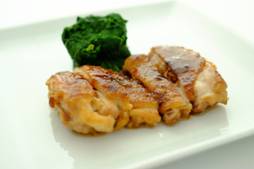
2 (600g) chicken legs, 3 tbs. plain flour, 1/2 tbs. oil
3 tbs. soy sauce, 2 tbs. sake (Japanese rice wine), 2 tbs. mirin (Japanese sweet rice wine), 1 tbs. sugar
1 bunch spinach

1.Poke chicken skin thoroughly with a fork.
2.Coat chicken with flour lightly and remove off the extra flour.
3.Heat oil in a frying pan and cook ②the chicken from the skin side over low heat with a lid for 5 minutes. Flip the chicken to cook the other side for another 5 minutes.
4.Remove the extra oil and slowly pour in the mixed seasonings. Flip the chicken several times to coat with the sauce thoroughly. When the chicken becomes glazed, remove from the heat.
5.Slice the chicken into bite-sized pieces and garnish with boiled spinach.

~ Teriyaki Tsukune (Minced Chicken Pattie) ~
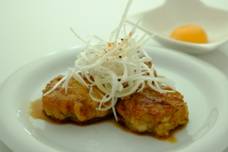
300g ground chicken, 150g long onion (naganegi) or onion, 2 tbs. plain flour, 1 tbs.soy sauce
1 tbs. oil
2 tbs. soy sauce, 2 tbs. sake (Japanese rice wine), 2 tbs. mirin (Japanese sweet rice wine), 1/2 tbs.sugar
4 egg yolks, 1 long onion (naganegi) or onion

1.Mince long onion.
2.Add the minced long onion, flour, soy sauce to ground chicken and knead thoroughly until the whole becomes smooth.
3.Divide ② the chicken patties into 12 pieces and shape into small ovals.
4.Heat oil in a frying pan. Place ③ and cook with a lid over low heat for about 5 minutes. Flip to cook the other side for another 5 minutes.
5.Pour in the seasonings and 2 tablespoons of water. Cook until glazed as flipping occasionally.
6.Place on a plate. Cut long onion finely into thin strips and garnish on top of Tsukune. Sprinkle Shichimi (blend of seven spices with hot pepper). Serve with an egg yolk as a dipping sauce, if desired.

~Teriyaki Hamburg Steak ~
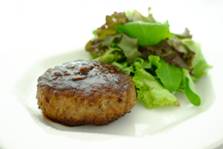
300g ground beef (or mix of beef and pork), 150g onion, 3cm carrot, 1 egg, 1/2 cup panko (breadcrumbs), 4 tablespoons milk
A pinch of salt and pepper, 1 tbs. oil
3 tbs. soy sauce, 2 tbs. sake, 2 tbs. mirin, 1 tbs. sugar
Several kinds of leafy vegetables

1.Mince onion and carrot. Heat oil in a frying pan and stir-fry minced onion and carrot until soften. Remove from the pan to cool down.
2.Add ①, an egg, and panko to ground beef. Pour milk over panko, sprinkle salt and pepper, and knead well until it becomes smooth. Divide into four portions and shape into ovals.
3.Heat oil in a frying pan and cook ② for 5 minutes. Flip to cook the other side. Pour 2 tablespoons of water, place a lid, and cook for another 5 minutes.
4.Pour in the seasonings and cook until glazed.
5.Place the Hamburg Steak on a plate and garnish with green salad.

~YAHATA MAKI ~
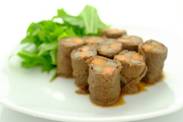
300g beef round slice, 1 carrot, 1/2 burdock, 1/2 tbs. oil
3 tbs. soy sauce, 2 tbs. sugar,
Mizuna leaf

1.Scrape off burdock skin and cut into halves or quarters. Boil for about 5 minutes and drain. Peel and cut the carrot into almost the same sized pieces as the burdock sticks.
2.Lay beef slice on a cutting board, place 2 sticks of burdock and carrot each on the edge of beef near you. Roll up the beef firmly, away from you. Place the beef roll in a frying pan with seam side down.
3.In the same frying pan, pour the seasonings and water over the beef roll till it just covers. Lid the pan and shimmer it over low heat for about 20 minutes. If juices evaporate, add water little by little.
4.Cut into adequate sized portions and place on a plate. Garnish with boiled MIzuna.

~Sukiyaki ~
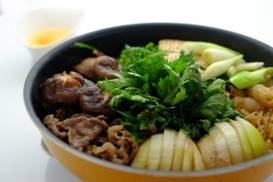
400g beef round slice, 1 tbs. oil
1 onion, 1 pack of shirataki, (noodles made from devil’s tongue yam), 2 long onions (naganegi), 1 bunch shungiku (Garland chresanthemum), 8 pieces shiitake mushrooms
1 seared firm tofu
6 tbs. soy sauce, 4 tbs. sugar, 4 tbs. sake
4 eggs

1.Cut onion into halves and slice 1cm wide pieces. Cut long onion diagonally into 1cm long. Cut shungiku into 10cm long. Cut off a hard stem of shiitake mushrooms. Cut tofu into bite-sized pieces. Boil shirataki and drain.
2.Heat oil in a wide, shallow steel-pan and stir-fry beef quickly. Add vegetables, sugar, sake, and soy sauce. When cooked, dip the ingredients into a beaten raw egg. Add tofu at an appropriate timing. When cooked, dip in a raw egg as well.
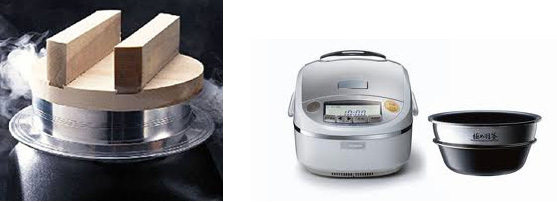
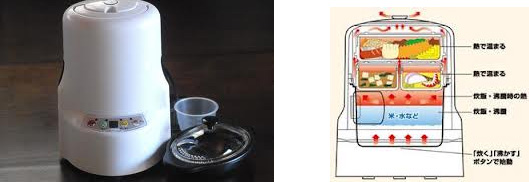
Various Rice Cookers

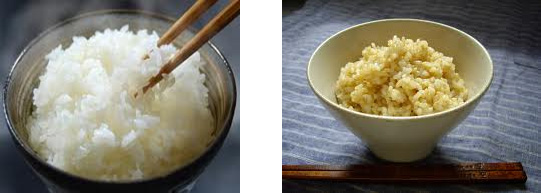
Because of the expansion of food globalization, rice consumption in Japan has been on the decrease. However, since rice is our staple food, every one of us feels comfortable when we have freshly cooked rice and miso soup. Naturally, since we eat it daily, our desire to have better rice grows.
From the standpoint of most Japanese people, delicious rice is as such: when cooked, every grain of rice looks glossy and plump and when consumed, slightly sweet and moderately sticky and elastic.

In the old days people used to put rice and water into a metal pot called hagama, cover it with a wooden lid and place the cooker on the furnace and cook it with a wood fire. A finely balanced heat control was necessary to produce delicious rice, so they didn’t leave the kitchen while cooking, and the room must have been filled with savory aroma of cooked rice.

After the post-war high-growth period, electric and gas rice cookers became widespread. Electric cookers, especially, have developed rapidly. It takes time and effort to make delicious rice, so home appliance manufacturers have studied the structures of the furnace and pot, developing appliances which operate on the same principles as the old method. Thanks to the electric rice cookers incorporating automatic timers and warmers, people are able to cook rice whenever they want, and eat hot rice any time.

In recent years, the trend of slow food and experience of blackout due to the 2011 earthquake have pushed us to utilize methods of cooking rice without depending on electricity. One of those methods is cooking rice using an earthen pot on the stove, while others love to use brand-name pots like Staub; all claim their method cooks rice better than electric cookers. I think those who adhere to having delicious rice tend to choose not to use an electric rice cooker.

Amongst the latest rice cookers, there is a unique one – an electric lunch box containing a rice cooker – useful for those who live alone. You just put the container with the rice and water on the electric heater, stack the other containers with dishes and miso soup on the rice container, then cover. During the cooking time of 40 minutes, the dishes and soup are heated as well as the rice, so when the rice is done, you have a complete hot meal! Freshly cooked meal is always the best.

Reported by Yukari Aoike, Sugahara Institute

Gokokuhojo – Plentiful Harvest of Five Grains

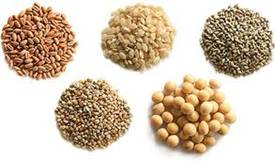
Since antiquity, the Japanese have prayed for plentiful harvests of gokoku – five grains. Well, what are they? Five grains consist of rice, barley/wheat, soybean, and two species of millet. Since the beginning of agriculture, people throughout the world have cultivated various kinds of grains. In Japan, they have grown the above five grains for their staple food.

For Japanese people, rice has been the most important of the five, but in earlier years, the rest of the grains were also very important in their lives. For example, barley and wheat were second-most important grains. It is said that the cultivation of wheat has about a 10,000-year-old history, and the methods of growing wheat and barley were introduced to Japan during the Yayoi period. They were grown as aftercrops for rice and mainly used as livestock feed. It was not until the Edo period that common people were able to eat flour products such as udon and manju with the advancement of millstone technology.

The soybean, often referred to as “meat from the field” is one of the important protein sources for the Japanese. It is also an essential ingredient for traditional seasonings such as soy source and miso, so it is natural that soybean was counted as one of the five grains.

Small gramineous crops such as foxtail millet, millet, and Japanese barnyard millet are collectively known as “millet”. These crops grow faster in less fertile and dry areas with fewer insect pests compared to major grains. Therefore, people grew millet as substitute grains to consume in lean years and/or as feed for birds and livestock. Common people in the past rarely had a ball of 100% pure rice; they usually ate mixed rice with millet and barley to make up for shortage.

It is only recently, however, that nutrients contained in millet have come to be valued. Nowadays we love to eat polished “white rice” which is lacking vitamins and minerals found in unpolished rice. Maybe we need to eat rice keeping in mind how important it is for us to get “plentiful harvest of five grains.”

Reported by Yukari Aoike, Sugahara Institute

Kite artist Tetsuya Kishida

Resource: The Japan Times
http://www.japantimes.co.jp/life/2013/03/27/people/kite-artist-tetsuya-kishida/#.UVVGAldjh_M

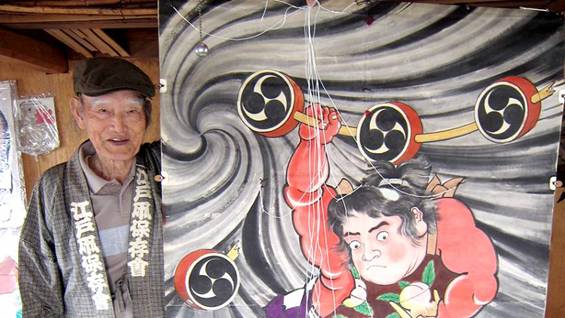
Japanese kite artist Tetsuya Kishida, 89, has been creating and flying kites since the age of 6. He used to be a salesman for the steel industry and he later sold bonsai. In his late 40s, he finally turned his hobby of painting kites into a profession. His artistic repertoire is inspired by images from musha-e, a genre of ukiyo-e (floating world images) that depicts samurai in battle scenes. He also paints Japanese heroes the from the Heian Period (794-1185) to the Edo Period (1603-1867), including kabuki stars. Although kite painting is his greatest passion, flying them comes a close second. Five days a week, weather permitting, he goes out with four similarly minded friends, and they fly their kites.

To lie on the grass and gaze at a beautiful kite above is the best feeling in the world. I rarely have this pleasure as I’m usually chasing my kites. That’s wonderful, too. I make Edo-style kites, which are stabilized by 14 to 17 lines that are connected to the sides of the picture and spaced at regular intervals. With these lines we balance the image so people on the ground can see it well. On the top, we add an extra bamboo pole that vibrates to create a wonderful buzzing sound as the wind carries the kite. This is what makes an Edo kite special. It lets people know that there is a kite above them. “Look up!”

Kites are a perfect way to study history. Kites are invested with prayers for children to grow into healthy and strong adults. This is why I paint strong characters. For example, Momotaro is a cute but powerful hero in Japanese folklore. When depicted as a baby, he is shown with peaches because he was found floating down the river in a giant peach. On a kite, however, he is depicted fighting demons, helped by his friends a dog and a monkey.

Kites come alive in the sky, and that’s how they bring happiness to all who see them. Kites awaken the carefree child in us. I’m often asked to paint my images on canvas so people can hang them in their homes as paintings. I really don’t like this idea because the whole purpose of a kite is for it to dance in the air and be seen by many, not to be caged in a room.

Don’t argue! I never do. I ignore the bad guys. Getting angry never gets positive results.

Every country must accept and follow international law. When Japan surrendered on Aug.15, 1945, I was a pilot at an air station in what is now North Korea. The Soviet army entered our camp. We were ordered by our commander not to fight as the war was over. We peacefully boarded the Soviet ships as we thought we were returning to Japan. We were packed in like sardines but we were happy, nevertheless. But when the ship entered port, we were in Nakhodka, a Russian city near Vladivostok. Imagine our shock! Next we were transported to Siberia. It was -45 degrees when we arrived and we had to walk for three days, about 100 km, to reach our camp. Many Japanese died on the way. For the next two and a half years I was in a Siberian gulag, working in horrible conditions. I’m lucky because I survived. Many of the 600,000 Japanese POWs did not. If the Soviets had followed international law, there wouldn’t have been suffering like that.

Enjoy life and don’t worry if you don’t fit the mold people want you to be in. Today’s rules will be broken tomorrow, anyhow.

Thanks to my spouse and her bento (boxed lunch) making, we got married. Soldiers like me had no idea about women. Hard to believe but true. We were drafted into the army as teenagers and we returned as men. Luckily, I met a woman who gave me a bento, then another, then another and so on. Somehow, we began talking and dating. We soon got married and this September will be our 60th wedding anniversary. I feel very lucky.

Getting a good deal means someone is not making enough money. In order to make beautiful kites we need time, but few people are willing to spend the money to make it worth the artist’s time. Everyone wants a good deal, but a good deal is usually pretty bad for the artist.

It’s easy to stay healthy when we love someone. I can’t get sick because it would be too tough on our daughter. She would feel the need to take care of me and that would break her.

If I didn’t fly kites, I’d be sitting at home — or in a nursing home. Running after a kite four to five hours a day keeps my body healthy and strong. The line is up to 200 meters long, so I need a lot of muscle strength to hold onto it. I never want to walk with a cane or sit in a wheelchair. When I die, I want to drop dead in a field with my kite in the sky.

Progress drives out old culture — literally. When I was a child, most people cultivated bonsai and had them outside in front of their homes. But once cars became popular, everyone turned their front yard into a parking space. Cars replaced bonsai.

If the weather is nice, go out! For my 88th birthday, my friends gave me many kites, so now I have to fly those as well as my own ones. I’m kept busy!

The Japan Times “Kite artist Tetsuya Kishida” by Judit Kawaguchi
http://www.japantimes.co.jp/life/2013/03/29/general/dine-with-a-backdrop-of-cherry-blossom/#.UVVEAVdjh_M

Ready for spring’s fresh bounty

Japanese people highly value the four seasons and it reflects greatly on our food culture. The seasonal foods play an important role in keeping Japanese people healthy.

・・・・・・・・・

Ready for spring’s fresh bounty

By MAKIKO ITOH

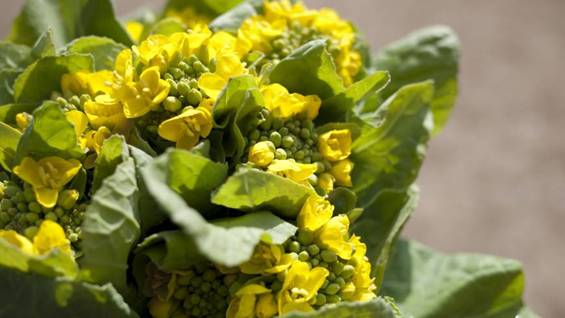
Vernal treasure: Closely related to broccoli, nanohana is best eaten in spring, when its buds are yellow-green. | MAKIKO ITOH

After an unusually cold winter, the sight of spring produce is particularly welcome, especially the bright yellow-green of nanohana. While plain-green nanohana is available almost year-round these days, it’s only in early spring when you see the ones picked from open fields that are covered in tiny just-emerging flower buds.

Nanohana is one of the oldest vegetables cultivated in Asia, including Japan. It’s closely related to the rapeseed or canola plant in Europe and the West, and also to broccoli, since all of these are members of the brassica family. While in the West rapeseed is usually only grown for its seeds, from which oil is extracted, in Japan the plant is used at various stages of growth. Each stage is given a different name, too: The young spring shoots are called nanohana, which literally means “flower of vegetable,” and the mature plant that’s used for oil as in the West is called aburana, which means “oil plant.” Rapeseed oil is called natane abura or “vegetable-seed oil” and has been used at least since the Edo Period (1603 to 1867).

While they are not as widely celebrated as sakura cherry trees, fields of yellow flowering nanohana are also a much-loved harbinger of spring, coming in between the ume (plum) blossoms that open in mid-February around the Tokyo area and the cherry blossoms that bloom in April. The word nanohana is a recognized seasonal word in haiku, signifying early spring. There’s also a well-known children’s song called “Oborozukiyo” (“Hazy Moonlit Spring Night”) that poetically describes a misty nanohana field in the early evening with a gentle spring breeze blowing over it.

Nanohana is a very versatile vegetable, high in vitamin C as well as other nutrients. It’s also a very frugal vegetable, since there’s nothing to throw away — the florets, stems and leaves are all edible. Unlike some other early spring vegetables, it has no bitterness or tannic quality, so it doesn’t need any special pretreatment. It both tastes and looks its best when the yellow flower buds are just emerging; once the flowers start to open the stems get a little tough, although you can get around this by cooking it just a bit longer.

As I’ve mentioned, nanohana is closely related to broccoli; I’ve seen varieties sold in the United States as broccolini or baby broccoli. The closest vegetable in the West might be broccoli rape, broccoli shoots that are popular in Italy. So you can use it in the same way you would use broccoli: simply steamed or boiled, stir-fried, in soups and so on. Nanohana is also excellent deep-fried with a tempura batter.

The most traditional way to eat nanohana in Japan, especially at this time of year, is as the side dish ohitashi. Simply cook the nanohana in boiling water until the stalks are just tender. Refresh under cold running water and drain well. Serve in a small bowl with some soy sauce or dashi stock mixed with soy sauce (3 tbsp of dashi to 1 tsp of soy sauce) and top with some katsuobushi (bonito flakes) or toasted sesame seeds. The bright-green florets with a sprinkling of yellow will add a colorful breath of spring to your dinner table.

The Japan Times:
http://www.japantimes.co.jp/life/2013/02/22/food/ready-for-springs-fresh-bounty/#.UUwEpldjh_N

Spring Foods To Help You Shed Your Winter Weight

Are you ready to take off your heavy winter jackets and enjoy spring fashion?
Here is a good article you may want to go through!

・・・・・・・・・

4 Spring foods to help you lose weight.

By Kerri-Ann Jennings, M.S., R.D. Former Associate Nutrition Editor for EatingWell Magazine

As spring nudges its way forward, some of us are left with an unpleasant souvenir of winter—an extra “layer.” Though that winter coat might have kept us warm through the long, cold season, by spring it’s time to shed the padding. The good news is many springtime foods promote weight loss naturally, and not just because they’re lighter than those hearty winter dishes.
Here are my top picks for spring foods to help you slim down.

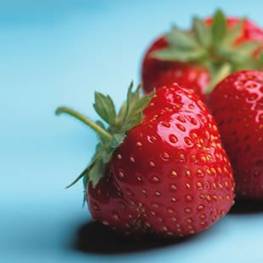
1. Strawberries
Strawberries’ fiber content makes them a good choice for weight loss. A two-year study published in the Journal of Nutrition found that people who ate 8 extra grams of fiber for every 1,000 calories per day lost about 4 1/2 pounds. (Women who decreased their fiber intake actually gained weight.) One cup of strawberries has a respectable 3 grams of fiber and more than a full day’s recommended dose of vitamin C—an antioxidant that helps keep skin healthy.
2. Eggs
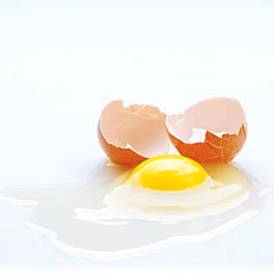
Eggs are packed with protein, which staves off hunger. In one study, dieters who ate eggs for breakfast felt fuller longer and lost more than twice as much weight as those who got the same amount of calories from a bagel for breakfast.
3. Salad Greens
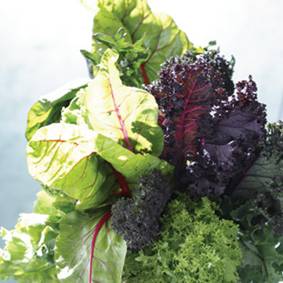
Filling up on fiber- and water-rich foods first can help prevent you from overdoing high-calorie fare later. Research out of Penn State shows that eating a first-course salad can reduce overall calorie intake at a meal by up to 12 percent. Not a fan of salad? Vegetable soups achieve the same result (in fact, a different study found that people who started lunch with vegetable soup ended up eating 20 percent less than those who skipped the soup).
4. Mushrooms
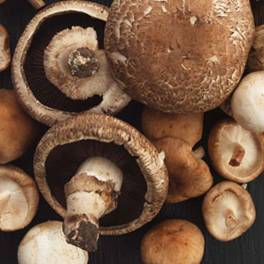
Mushrooms taste meaty, but have only a fraction of the calories and fat of red meat. Research reports that when people ate mushroom-based entrees, they felt just as satisfied as when they’d eaten those same dishes made with beef.



URL: http://www.eatingwell.com/nutrition_health/weight_loss_diet_plans/
diet_exercise_tips/spring_foods_to_help_you_shed_your_winter_weight

Welcome Spring With Fresh Skin Care & Makeup Ideas

Now is the time for seasons to change and we pay close attention to our skin care. Here is the article I believe it worth reading!

・・・・・・・・・

Welcome Spring With Fresh Skin Care & Makeup Ideas
By Dr. Daniel Shapiro, FACS, Shapiro Aesthetic Plastic Surgery and Skin Klinic


Photo courtesy of Dr. Shapiro

As days grow longer and the spring equinox approaches, it’s a good idea to start thinking about transitioning your makeup from its winter routine. Here are some tips to help you prepare your skin for warmer weather and refresh your look for a new season.

Rethink your moisturizer. Winter is very hard on skin. Extra-hydrating moisturizer is a must with cold, harsh weather outside and dry heat from the furnace inside. However, using these products in warmer weather can turn your skin greasy and uncomfortable. Switch to a lighter moisturizer in the spring for better results. Many women swear by moisturizing gel creams; check to see what your favorite beauty brands offer. If your skin is dry year-round, try a rich night cream to keep your face supple and soft, and use a lighter formulation during the day.

Lighten up. Women often use more makeup during winter to give sun-deprived skin a boost of color. Take a more subtle approach for the spring. Put away your lipstick in favor of a gloss or tinted lip balm. Swap your foundation for a tinted moisturizer for a more natural look. If you find you still need a bit more warmth, dust on some bronzer.

Experiment with new shades. Welcome the season by trying out some new makeup colors. Switch from black to brown eyeliner for a very easy spring look. Eye shadows in all shades of green (really!) are huge this year. Truly fashion forward? Take a cue from the Spring 2013 runway shows and try a coral nail polish or cherry red lipstick.

Don’t forget the SPF. It’s important to protect your skin from the sun year-round, of course, but you’ll certainly spend more time outside as the weather warms. Always use sunscreen, and make sure to choose skin care products with SPF to protect yourself from damaging UV rays.

URL: http://sheacorridor.azcentral.com/news/health/51304-welcome-spring-fresh-skin-care-makeup-ideas

Okinawan Vegetable ②Shima-ninjin

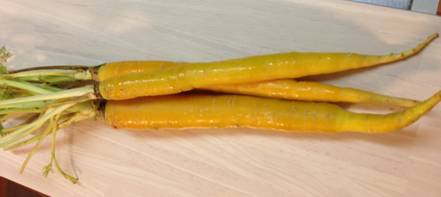
I would like to introduce another Okinawan vegetable, “Shima-ninjin.”

“Shima-ninjin” is originated in the East. It is yellow, thin, and as long as 30 to 40 cm. Despite how it looks, it is called in Okinawan dialect “chide-guni,” meaning “a yellow radish.” “Shima-ninjin” used to grow all over Japan, but now it can only found in Okinawa.

Compared to the general orange carrots, “Shima-ninjin” is sweeter, softer, and has stronger smell. It contains abundant of Vitamin A, which is effective to relieve eyestrain. Just like the regular carrots, when cooked with vegetable oil, absorptivity of Vitamin A increases. I recommend eating “Shima-ninjin” often especially in cold season because carotene of “Shima-ninjin” helps our body temperature to rise. In addition, “Shima-ninjin” contains calcium, iron, and antioxidant, lycopene much more than the regular orange carrots.

For its nutritional value, “Shima-ninjin” has been appreciated as a medical food in Okinawa for a long time. It is an evitable ingredient to make Okinawan local soup with chopped pork and other vegetables. It also makes delicious tempura or stir-flies.

The best season of “Shima-ninjin” is short, between November and April. When you come across with it, I hope you don’t fail to try because it is rarely seen in a market other than those relevant seasons.

Reported by Tomomi Tanaka, Sugahara Institute