Easy Home Gardening using 100-yen store goods

Right after I visited Mr. Ito in Yokosuka to interview for a radio show, I started this home gardening at home.  Please check his book for more detailed information.  “Hydroponics with 100yen Goods.”
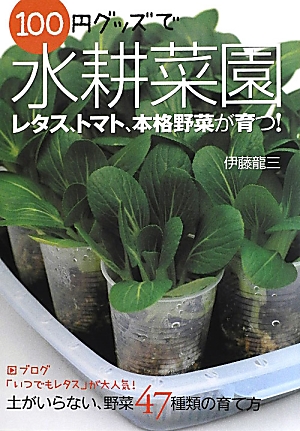
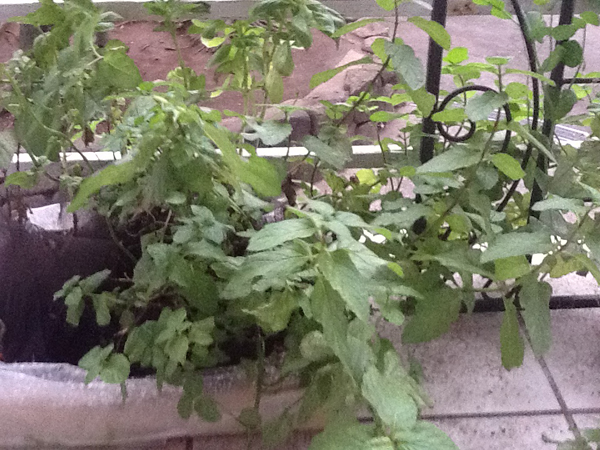
Prepare a 3cm-deep plastic tray, available at a 100yen store.  Select your favorite seedlings with soil around roots, approximately as high as 10cm.  Stuff them in a mesh filter bag fully.  Then place expanded vermiculite (an ore, pumice type) about 1cm wide all around the bag.  I have 10 plants of mint and roquette.  I also have a plant of snap peas.  Now it has gotten cold to leave the plants outside, I recommend that you keep the plants indoor or start in March, if you are interested in trying.

Get a liquid fertilizer, HYPONICA (available for \1200 on-line shopping) and dilute it with water for 500 times.  I usually keep the diluted fertilizer in six of 2-liter plastic bottles.  Pour the diluted fertilizer up to 1cm deep in a tray.  When it’s almost gone, add some more up to 1cm deep again. 
That’s it!  My plants have grown much bigger than those must have been if planted in soil.  Mint and roquette have become over 40cm high with a full of branches and a stem as thick as 1cm. 

I am planning to try mini tomatoes soon.  My office staff has experimentally planted a tomato from a seed and I’m going to use one seeding from hers.  Now it is as tall as 20cm.  I’m planning to move the plant inside my house so that I can get some tomatoes. 

The points that I like about this home gardening using the liquid fertilizer:
1.You can prepare the materials cheap at a 100yen store.
2.Making the diluted liquid fertilizer is so easily that you can keep it in a stock. 
3.The plants absorb the liquid fertilizer much more directly than those planted in soil as if babies drink milk.  That stimulates the plants to grow quickly.
4.It is okay to have several plants together in a tray, and you can even place several trays in a small balcony.
5.Utilizing this technology in the upcoming low eco-growth era in earnest, we can grow vegetables like tomatoes, cucumbers, lettuce, and others which will help our family expenses in a long way.

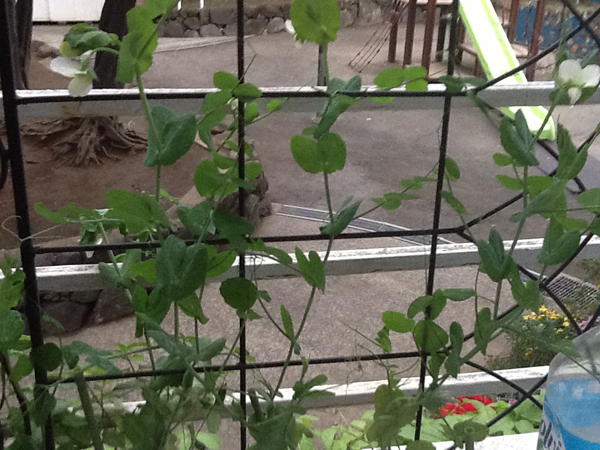
Just be careful not to pour so much liquid fertilizer that it covers the stem for 2 or 3cm high.  It may lead to rot the root.  Mr. Ito showed me that he could get more than 10 baskets of mini tomatoes from only 5 plants!  I was so amazed and that’s how I made up my mind to try by myself!!  Now I can have a fresh mint tea every day.  My fresh roquette adds excellent flavor to my salad.  My snap peas have bloomed flowers under the cold sky of December.
Spaghetti developing in Japan

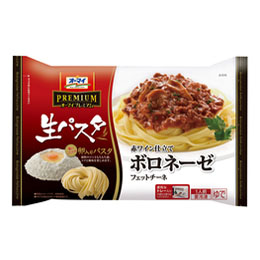
During such a low-economic growth era, we tend to be hesitant to spend our money. Instead, we are more likely to enjoy looking for novel foods in our everyday life. One of the trends I’ve found is that many restaurants now serve fettuccine (noodles in flat strips) with ragu sauce, the beef cheek stewed in wine. To my surprise, I also found it already sold in a frozen pack at a grocery store.
ght when I had a chance, I decided to try fettuccine with ragu sauce in a frozen pack with my original arrangements. First of all, I felt the sauce was not quite enough and it would become better if I increased the volume of sauce. So this is what I did. Take 100g of ground meat and cook with salt and garlic. Add maitake mushroom and red wine to the ground meat and season with ketchup, and Tonkatsu sauce (thickened Worcester sauce). Heat up the frozen-packed spaghetti and mix with the additional ground meat. Unexpectedly, it turned out to be much more delicious than we had expected and we liked it so much!

You may be wondering why I don’t start from scratch if I use so many additional seasonings. But it is much easier this way by saving some preparations. If I didn’t have a sample frozen-packed spagetti, we would not have fettuccine with ragu sauce on our dinner table. Using the rest of maitake mushroom, I quickly made a salad by adding snap peas, avocado, mini tomatoes, boiled shrimp and lemon juice.

a restaurant. I can already buy it in a frozen-pack at a grocery store. I’m sure this has already been in market for over a couple of months. I’m just amazed how fast this spaghetti is changing.

Make-up, a good way to keep you healthy!

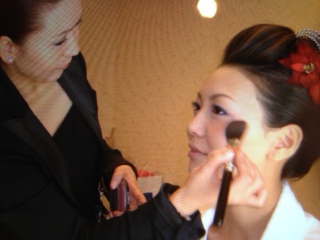
The other day, I went to help with a volunteer activity to make up handicapped children.  They were so excited because they have never had make-up on before.  As the make-up went on, they started to have bright smiles on their faces as if roses bloom under the morning sun.  We were the ones to provide, but it was us who got deeply impressed by those children more than we had expected. 
I really think a make-up has a power!  Most of the developed countries are becoming aging societies.  Because we are living in such times, it is important to have a full make-up on to trick ourselves to look younger.  I’m sure that we will feel happy and confident when we find ourselves look younger in the mirror and that shall encourage us to lead a happy life. 

Decades ago people used to have a negative belief toward women over 60 years old having make-up on that those women were presumptuous.  But now the women in the same age range of those in 20 years ago look much younger by 10 to 20 years old.  Of course, they have become younger physically, in muscle health wise.  This is not just an outcome of being effected by the power of make-up.  Looking younger than your actual age surely stimulates your female hormones, growth hormones, and immune systems. 

I think this has a direct effect on reducing medical expenses after all.  The Recent hair dyes have improved quality so much to help us look younger.  I assume that not many people are aware of how much gray hair they actually have. 

Considering our second life starting from the age of 60, it may continue 30 years or more.  So let’s straighten up our back, put on an appropriate make-up, and dress-up accordingly!  These are the tips to make ourselves bright as well as the whole society!  I hope that even men, if possible, should have make-up on in a casual manner from now on.

Science of Autumn Tints

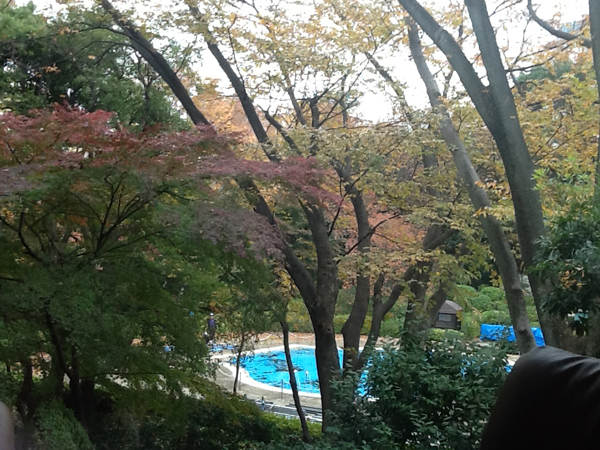
The photo shows the autumn leaves in Tokyo.  This is only one thirds of all but lined Ginkgo biloba trees are beautiful in yellow.  In recent days, science has clarified why leaves turn colors in autumn.  Leaves are green because of chlorophyll.  In autumn, chlorophyll decomposes.  What’s been left is carotene creating yellow as of Ginkgo biloba trees.  When anthocyanin remains, it creates a color of red, typical to Japanese maple trees.

But we’ve already known that such pigments are effective antioxidants for restraining aging and we can take them into our body through vegetables.  Isn’t it surprising that tree leaves contain antioxidants?  You may not have imagined making supplements from wild tree leaves.  But have you heard of an extract essence of Ginkgo biloba leaves?  This is what xanthophyll and carotene of the leaves are condensed and it is already put into practical use.

Have you ever heard of flavangenol, an extract essence of a pine tree?  It is consisted of 3 carotenes.  Its effects as antioxidants have been paid attention well enough to use as supplements or cosmetics. 

While seasons change, everything changes as well; no exceptions.  We, Japanese people have learned from our mother nature that we cannot stay in the middle of glory for good…in addition, we should not be attached to doing so either.  Not only that, I’ve been thinking lately that we can learn from science nature lies in quiet but with full of marvelous antioxidants.

School Lunch in Adachi City, Tokyo

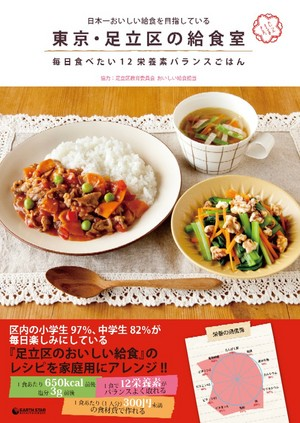
Do you know that School Lunch in Adachi City (Tokyo) has been paid close attention from all over Japan? “Japan’s Most Delicious School Lunch” is the motto of Adachi City. I can tell they have gone for a step ahead compared to typical conservative plans that administration may have. I had a chance to interview the author of this book, who is a subsection chief representing the School Lunch section of Adachi City Office for a radio show the other day.

As a professional nutritionist, I have been concerned about the school lunch system, in which the cooking is done at a center, and which is usually committed to private companies. Although it was almost a decade ago, school lunch seemed to be inclined to go against food education. A good example is one lunch menu when udon noodle was served with rice. The udon noodle is packaged in a plastic bag which children are required to open to a soup bowl by themselves. Because of the udon noodle, a spork (a spoon the edge of which are shaped like a fork) is prepared instead of chopsticks.

Recently, an attention has been focused on food education in nationwide and school lunch has been developed a trend to have Japanese style menus more. Along with that, a plan also has a goal to educate all children to use chopsticks properly. Among of all the efforts, Adachi City is prominent because the female mayor adopted food education as one of the major policies 5 years ago. Delicious school lunch will make children happy and smile. Now that all the school lunch in Japan are well-balanced and includes all 12 nutrients. I expect it affects on children’s physical and mental health, the sense of taste, and good action of the cerebrum. The salt level in each meal is maintained to be 3g. This is quite low.

The famous ramen noodle restaurants that host a line of people usually serve one bowl of ramen noodle with 5 to 10 grams of salt in it. Once accustomed to such a food, it is natural for children to dislike less salty meals. But it is mandatory that school lunch provided in Adachi City use natural soup stock and seasoning. They have proved that such natural soup stock and seasoning can make delicious, satisfactory meals with low salt level. But how?

If children find school lunch is not their taste, they usually do not eat. So the amount of leftover can tell whether children liked the day’s school lunch or not. All the schools in Adachi City have adopted this method. When small fish, liver, or seaweed such as hijiki and wakame are used for the menu, the leftover simply increases. But in Adachi City where a delicious school lunch is provided, it does not happen. The leftover in the year of 2010 was 5.5% in elementary schools and 10% in junior high schools, which are both relatively low. The figure is even 4% lower owing to the better seasoning, better arrangements of foods, and much more fun lunch time. This is a great outcome of Adachi City’s method. Children eat fish, soy beans, and seaweeds. Each menu includes around 250g of 10 to 15 different kinds of vegetables.

Each meal costs about 254yen, almost as equivalent as a cup of coffee. If we want to use the same ingredients at home, it will probably cost nearly 500yen. I can tell this is almost a miracle that school dietitians and cooks have combined their efforts and passions to make a delicious school lunch. In fact, even though we are living in what is called a “satiation period,” 97% of children have answered that school lunch time is fun. Can you imagine how those children who bear our future on their shoulders are having delicious, fun school lunch with smiles every day? 20 and 30 years later when they grow up, they are healthy and able to eat anything. Moreover they grow up to be able to cook such meals at home. I can imagine the future Japan is full of sophisticated people who have been taught so by traditional Japanese food and elegant manner of chopsticks. Am I thinking too much?

I’m just happy that one book is having an important impact on recent Japanese School Lunch.