Hydroponic Tomato Experiment ② – Germination

In the previous article I wrote about how I planted cherry tomato seeds. Once you plant seeds, you have only to evenly refill the water daily if the water level has decreased. We had some hot days with daytime high of almost 30 degrees C at the end of last September as well as in early October. I remember that the water level dropped very quickly. The cherry tomato seeds sprouted a week after the seeding.

Slender sprouts resembling kaiware-daikon came out all at once. Since this was my first time growing tomatoes, I was concerned whether such frail shoots would grow well.

As you can see, both the sprouts from the tea filter bags and the sponges look good. You still have to refill the water when needed. After the germination, the sprouts grew amazingly well. At this point, you should place the plants in direct sunlight. The sprouts firmly grow seeking sunlight. They grow towards the sun. Take a look at the following pictures.


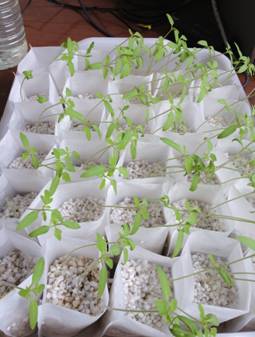
Eight days after germination


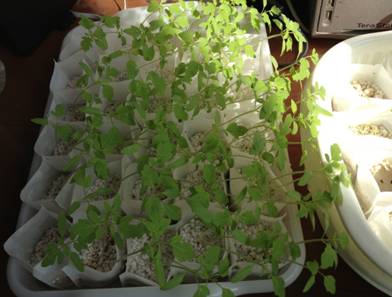
13 days after germination

Leaves got stronger. They are ready to be transplanted. You can transplant the seedlings before they have grown to what you see in the picture as 13 days after germination. I recommend that you transplant the seedlings as you see in the above picture as 8 days after germination.

You will need to transplant the seedlings from the tray to a new housing. From this stage, more effort is required and I bought some necessary tools for the transplanting work at a 100-yen shop.

Hydroponic Tomato Experiment ① – Seeding

As I mentioned in the past entry, “Easy Home Gardening using 100-yen store goods,
I’ve been experimentally growing cherry tomatoes since the end of September 2012. For cherry tomatoes, the time of seeding is usually spring but I planted seeds at the end of last September. I’ve been growing the tomato plants indoors using a hydroponic system, which is easy and allows plants to grow well, and I want to see if the plants grow vigorously during winter. Following is my report on the experiment and in this article I show you how the seeds were planted and how they sprouted.

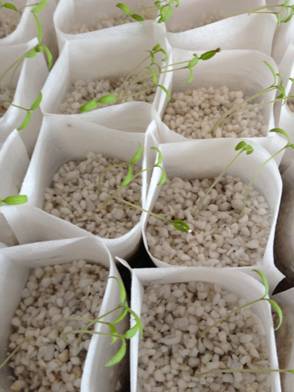
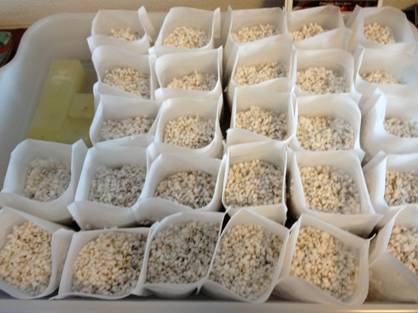
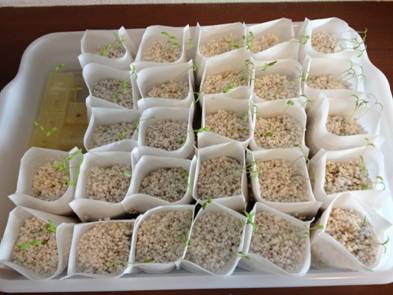
This picture was taken at the time of seeding. I used a tray, Japanese tea filter bags, and Perlite. These are sold in 100-yen shops. I filled the tea filter bags with Perlite 3 centimeters high on the tray, poured the water into the Perlite so that it was level in the bag. Then I planted tomato seeds on the Perlite.

I didn’t know what the germination rates of the tomato seeds were, so I put 3 or 4 seeds in each tea bag. However, that was too much; putting in one or two seeds will do. Because the germination rates were 100%, I was surprised at the power of seeds.

After planting seeds in each bag, I covered the seeds with a small amount of Perlite, and then filled the tray with water to half the height of the tray (about one centimeter). You should keep your eye on the water level and as the level decreases, refill the tray with water. At this stage, perhaps all you should watch is the water level.

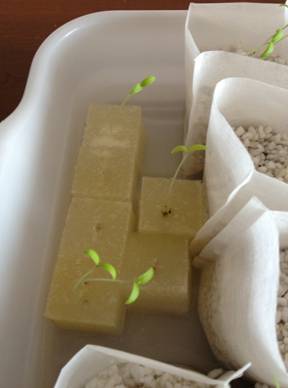
Notice the sponges at the top left in the above photo. Since there was space on the tray, I used those sponges as plant beds on which to put seeds. I cut a slot in each 1.5-centimeter cubic sponge and put seeds in the slot. I soaked the sponges in water. Both methods of seeding made the seeds sprout well. So far, all that was required was putting Perlite into tea filter bags and cutting sponges. Very simple!

Memorial Service for Ancestors in Okinawa: Shi-mi- 

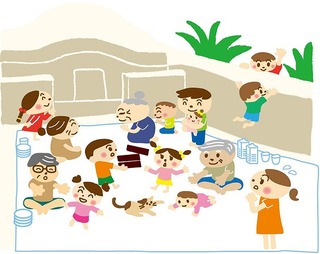
On weekends of mid-April, you can see local people gathering in front of the graves all over Okinawa. This is called “Shi-mi-“and it is a memorial service for the family’s ancestors. It is an important Okinawan custom to visit their family grave once a year.


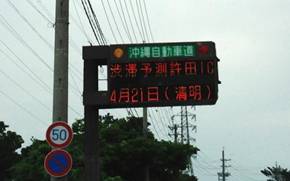
Electric Bulletin Board at Entrance to Expressway

Many Okinawan cultures have been greatly influenced by China. Even in recent days, we still practice many annual events based on the lunar calendar. The memorial service, “Shi-mi-”is derived from one of the twenty-four seasons of the lunar calendar in China, called “Seimei.” It falls on between February and March of the lunar calendar and it is the time when flowers and trees start to grow and things liven up. That is why Chinese made it a custom to clean their family grave and recall the deceased. In Okinawa, Shi-mi-, the Lunar Bon Festival, and Lunar New Year are the three biggest memorial services for the ancestors. Okinawan people do not have a custom to visit a grave as often as mainland Japanese people, so Shi-mi- is a very important annual event for the local people.


Okinawan grave has a unique shape and it looks a lot different from that of found in mainland Japan. Having a gate and an open space in front, it looks as if it were a house. When visiting a grave for Shi-mi-, the first thing to do is to clean around the grave to make enough space for everyone to sit down. Then, spread a picnic sheet and open the offerings that each family prepares.

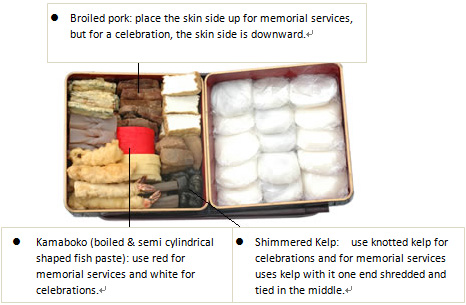
Offerings for the ancestors in Okinawa are always packed in 2 layers of square boxes, called “Ju-bako.” There are strict customary rules for what to fill the boxes with and how many pieces to put in. There must be 3 rows of 5 pieces of round rice cakes in the first box. And in the second box, there must be 9 kinds of food; white and red kamaboko (boiled & semi cylindrical shaped fish paste), deep-fried tofu, tempura, deep-fried taro, shimmered kelp and burdock, konnyaku (jelly made from devil’s-tongue starch), and broiled pork. It is okay to change ingredients for tempura or shimmered vegetables and have different flavors of rice cakes besides plain kinds, but the numbers of pieces and kinds of foods must always be odd numbers.


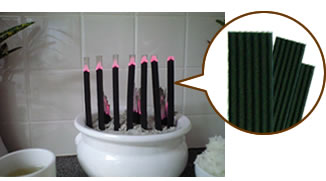
We place the Ju-bako offerings, fruits, snacks, and each glass of water and Japanese wine in front of the altar. We burn black and flat incenses (peculiar to Okinawa) as we pray for the peaceful life and everybody’s health during the past year and for the coming year.
It is believed that the ancestors are enjoying the offerings while the incenses are burning so the family members enjoy chatting with relatives meanwhile. When the incenses are burnt, we pick out one or two pieces of food from each container and flip them over. (This means that the ancestors have eaten the food.) Then, we thankfully share the offerings together.


If non-Okinawan people see us doing “Shi-mi-” without knowing, I’m sure they will be so surprised and wonder “Why do they have picnic in front of the graves?” But in Okinawa, as many people believe in a concept of Ancestor Worship, Shi-mi- is like a having dinner with our ancestors who just happen to be unseen. Many Okinawan people don’t have religions. Instead, we believe that our ancestors for many generations become our guardian spirits after being passed away and they help us and lead us to take the right paths in our lives. When we are struggling, we regard it as the obstacles that our ancestors provide us on purpose so that we can develop to become more decent people. Ever since I was a child, my mother has taught me that we owe what we are today to our ancestors so we must not forget to be grateful for being who we are.


Also in a concept of Ancestor Worship believed in Okinawa, one’s spirit will reach the stage of a god at 33 years anniversary of their death only if the living descendants hold annual memorial services in proper ways. At the Shi-mi-, the elder members of the family always talk about such customs of Okinawa. They also tell us never to waste our precious lives that we were given from our ancestors, always to keep close bonds with family and relatives, and to be thankful for peace life.

In Okinawa, it is a custom that the first son of the family and his wife will rest in the family grave. For that reason, they inherit the house and become responsible for taking care of the family altars and holding the memorial services all through the year. It is my cousin, my father’s first brother’s first son, who is responsible for our family altars and grave even though he is much younger than my father. In my paternal family grave we visit every year, who are buried are my father’s first brother and his wife, my father’s parents, their parents, and four more generations. Of course, they were all first sons of the family in each generation. Tracing back where this grave was branched off, our family tree might have descended from a family in Shuri, an ancient capital of Okinawa. But this is a very old story that nobody knows the correct family tree anymore. This is also an established subject to talk about at Shi-mi-.

My father is the sixth son, so he cannot rest in his parent’s grave. When the time comes, he has to build his own grave. And my brother and his wife will go in sometime later and their son and his wife. This is how it continues.

Basically, we go for Shi-mi- where our parents rest in. Paternal side takes the first priority. Without exceptions, we visit my father’s family grave and if possible, we also visit our mother’s family grave. If they schedule on the same day, we deliver our offerings to the relatives in advance and ask them to pray for us.

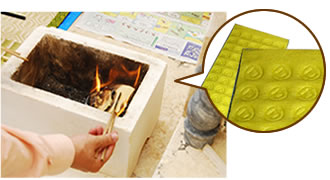
If the weather permits, we usually stay at the grave for an hour or two, but it often rains in Okinawa around Shi-mi- time, so it is okay to leave right after providing offerings. (This year it was raining hard from the morning, so my parents and my brother went to serve incense only.) After sharing offerings, Shi-mi- ends when we burn “Uchikabi,” a farewell gift for our ancestors to take back which is regarded as money in the other world. Uchikabi is yellow and similar to paper towel. It can be purchased at any local stores.


How did you find Shi-mi- event?
Okinawa is a part of Japan but we have our own peculiar customs and culture.
I take Shi-mi- for granted since I was a child, but as I reflect on deliberately, I realize there are deep meanings in every small detail. I’d like to learn more about my own customs and cultures so that I can pass down to next generations.
To complete this column, I referred to a web site which introduces Okinawa in many different fields. I found it very interesting and useful for not only those who are interested in Okinawa, but also for those who were born and raised in Okinawa like me. I’m sure you’ll enjoy it. Please check it!!

http://www.okinawastory.jp/special/tokusyu_1002/0600007029.html

Reported by Tomomi Tanaka, Sugahara Institute

Anti-Aging Foods For Women


Image courtesy of iStockphoto / Thinkstock

Today, people are searching for ways to keep themselves feeling and looking younger. In addition to keeping an active lifestyle, eating well can decrease risk of heart disease–the no. 1 killer of women in America—as well as other health issues.

Eating a fresh whole-food diet rich in antioxidants, vitamins and minerals will keep women of all ages feeling and looking their best.

Here’s a brief list of foods that have been shown to fight the effects of aging in women:

Berries
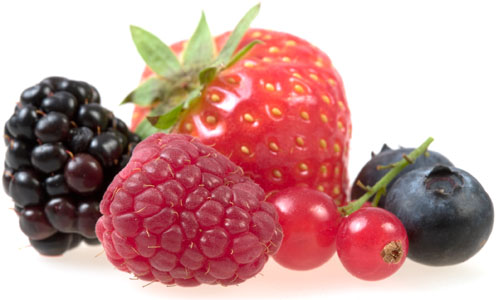
Blueberries, strawberries, cranberries, blackberries and gooseberries are all foods that are rich in flavonoids, which are powerful antioxidants, one of the greatest anti-aging assets found in organic foods.1

Berries protect against the deterioration of cognitive and motor functions, reduce oxidative stress, lower inflammation and improve brain cell signaling, according to Dr. Barbara Shukitt-Hale, Ph.D.

They’re also a great source of vitamins and can even ensure proper blood flow. Besides flavonoids, berries also are loaded with other nutrients, including vitamin C, potassium and folate (vitamin B9).

There’s a large amount of fiber in a daily serving of berries, which also offer digestive benefits. Consuming berries on a consistent basis provides the body with minerals and salts that destroy free radicals, which helps protect women against aging. Shukitt-Hale suggests 1 cup of berries per day to prevent memory loss, lower disease risks and curb weight gain.

Extra Virgin Olive Oil
Olive oil provides the clean, healthy fats the body needs to maintain healthy skin and hair throughout life. In general, “good” fats—monounsaturated fatty acids in olive oil’s case—are lacking in the diets of most North Americans. Extra virgin olive oil represents your best choice because it is minimally handled and processed, and it tastes delicious.

When cooking with olive oil, never heat the oil so much that it begins to smoke. Use low to medium heat only, and monitor the oil. Once it starts to smoke, olive oil actually turns rancid.

Salmon
In order to keep skin supple, women are encouraged to eat about 12 ounces per week of wild salmon, as suggested by the American Heart Association.

Salmon also contains omega-3 fatty acids, is rich in vitamin B12, vitamin D, reduces inflammation and slows the progression of chronic disease. Salmon is known to reduce blood pressure, a common health issue for women over 50.2

Dark, Leafy Greens
Kale, spinach, collard greens, romaine lettuce and Swiss chard are dark green vegetables that are full of vitamin C, vitamin K, folic acid, iron, potassium, calcium and magnesium. The vitamin B in greens guards the heart and memory. Vitamin A supports skin cell turnover, and the lutein found in many forms of green vegetables protects vision.

According to Martha Clare Morris ScD, director of the Center of Nutrition & Aging at Rush University Medical Center in Chicago, those who eat three to four servings of greens a day will experience less of a decline in memory, recall and other mental functions. Morris and her team have tested 37,000 people.

The antioxidants in greens prevent fine lines and wrinkles. Lycopene, lutein and beta-carotene–commonly found in green vegetables–help block UV rays that cause skin to age rapidly. The nutrients in greens help fight against cardiovascular disease, asthma, rheumatoid arthritis and may even prevent certain types of cancer.

Garlic
Garlic is equally as delicious as it is good for you. Garlic is part of a class of vegetables known alliums, which help support your liver’s natural ability to neutralize and remove toxins and carcinogens. To prevent cell degeneration, garlic keeps blood thin and also prevents heart disease.3

Like many of the other foods on the list, garlic is rich in antioxidants. It can help limit the growth of abnormal cells and increases blood flow that goes to the brain for awareness.

According to Dr. Ian Smith M.D., garlic also helps fight acne, prevent dandruff and kill bacteria.

What You Can Do
Eating healthy is not about depriving yourself of the foods you love. Rather, it’s about fulfilling your body’s needs for vital nutrients. With the right dietary information, you can keep your body looking and feeling fantastic for life.

To get the nutrition news your body needs, contact your nearest Maximized Living doctor, or subscribe to our newsletter, which features all the latest health news.

_ _ _ _ _ _ _ _ _ _ _ _ _ _ _ _ _ _ _ _ _ _

Check the original site for more detailed and useful information!
URL: MaximizedLiving:
http://www.maximizedliving.com/Home/MaximizedLivingBlog/tabid/772/Article/816/anti-aging-foods-for-women.aspx

Tips for a Safe and Healthy Life

Take steps every day to live a safe and healthy life.

Eat healthy.

●Eat a variety of fruits, vegetables, and whole grains every day.
●Limit foods and drinks high in calories, sugar, salt, fat, and alcohol.
●Eat a balanced diet to help keep a healthy weight.

Be active.

●Be active for at least 2½ hours a week. Include activities that raise your breathing and heart rates and that strengthen your muscles.
●Help kids and teens be active for at least 1 hour a day. Include activities that raise their breathing and heart rates and that strengthen their muscles and bones.
●Physical activity helps to:
  ○Maintain weight
  ○Reduce high blood pressure
  ○Reduce risk for type 2 diabetes, heart attack, stroke, and several forms of cancer
  ○Reduce arthritis pain and associated disability
  ○Reduce risk for osteoporosis and falls
  ○Reduce symptoms of depression and anxiety

Protect yourself and your family.

●Wear helmets, seat belts, sunscreen, and insect repellent.
●Wash hands to stop the spread of germs.
●Avoid smoking and breathing other people’s, or (second hand), smoke.
●Build safe and healthy relationships with family and friends.
●Be ready for emergencies. Gather emergency supplies. Make a plan. Be informed.

Manage stress.

●Balance work, home, and play.
●Get support from family and friends.
●Stay positive.
●Take time to relax.
●Get 7-9 hours of sleep each night. Make sure kids get more, based on their age.
●Get help or counseling if needed.

Get check-ups.

●Ask your doctor or nurse how you can lower your risk for health problems.
●Find out what exams, tests, and shots you need and when to get them.
●See your doctor or nurse for regular check-ups and as often as directed. Get seen if you feel sick, have pain, notice changes, or have problems with medicine.
_ _ _ _ _ _ _ _ _ _ _ _ _ _ _ _ _ _ _ _ _ _
Check the original site for more detailed and useful information!
http://www.cdc.gov/family/tips/index.htm
Source: Department of Health and Human Services
Centers for Disease control and Prevention

TERIYAKI ④

Typical Japanese recipes which have a luster and the fragrant smell appealing to our appetite include spitchcocked eels and grilled chicken, yakitori. Specialized restaurants for those recipes usually have their own traditional sauce succeeded from generations. It is not too much to say the sauce has the most important effect upon its flavor.

The base of the sauce is a mixture of soy sauce and sugar, into which the fat of eels or chicken melt over the past years, creating their original flavor. Such sauce aged for years is the restaurant’s priceless property; therefore, it is believed that the sauce pot is the very first thing to carry out when fire or natural disaster occurs.

~ Spitchcock Eel ~

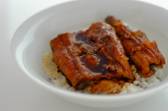
4 eels broiled without seasonings, 6 Tbs. soy sauce, 4 tbs. sugar, 2 tbs. mirin

DIRECTIONS:
1.Pour sugar and mirin in a pot. When boiled, add soy sauce. When boiled again, remove from the heat.
2.Place broiled eels in a frying pan and cook over low heat. Pour in 2 tablespoons of water and cook with a lid for about 5 minutes.
3.Pour the preserved seasoning ① in a pan and cook until it coats thoroughly around eels and glazed.
4.Place the glazed eels over a bowl of steamed rice. It makes tasty “Unadon.”

~ Pacific Saury Spitchcock-style ~

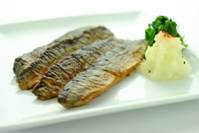
4 Pacific sauries, 4 tbs. plain flour, 4 tbs. oil, 2 tbs. soy sauce, 2 tbs. mirin, 1 tbs. sugar
Japanese white radish as needed, Green leafy vegetables as needed

1.Cut off the head of Pacific saury, remove the guts, and fillet. Quickly wash the fillets and dry well with paper towels.
2.Coat the fillets with flour lightly. Spread oil in a heated frying pan and stir-fry both sides until brown.
3.Blend soy sauce, mirin, and sugar well. Pour in the pan and cook until juice is gone.
4.Place on a plate and garnish with grated Japanese white radish and boiled green vegetables.

~BBQ ~

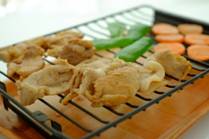
500g pork, 500g chicken,
Adequate amount of green pepper, onion, carrot, and other vegetables to your taste
3 tbs. soy sauce, 8 tbs. sake, 3 tbs. sugar, 3 tbs. sesame oil

1.Blend soy sauce, sake, sugar, and sesame oil well. Marinate meat with the seasonings.
2.Cut vegetables into bite-sized pieces.
3.Heat a grill well and cook meat and vegetables.

Barbeque in Okinawa

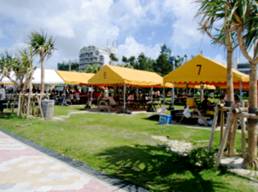
In Okinawa, the sub-tropical island surrounded around beautiful beaches, people love to barbeque as it’s called “beach party.” It is possibly true to say that local people go to beach for having barbeque rather than for swimming. Most commercial beaches are usually facilitated with rental barbeque equipment and you can also order barbeque set at the same time. Barbeque set (equipment and ingredients) is also available at many meat shops in town and they often have a delivery service to the designated beach.

Starting from June when rainy season ends up to the early October is the barbeque season in Okinawa and beaches are full of people enjoying barbeque. Some people like to have barbeque at camping, parks (where approved only), or even at personal house garden. Having barbeque is not extraordinary activities among Okinawan people.

Considering the preparation of equipment and the amount of food, barbeque is usually set up as a big party for more than 10 guests. Generally, the average number of guests is 20 people. It is common for Okinawan people to have a barbeque at least once in a summer with family members, friends, co-workers, sports club team members, children’s friends, or as a class reunion. There may be some people who have beach parties every weekend during summer.

The beach party usually takes all-day. We usually start before noon and stay at the beach till the sun set. It is a very casual party so the guest will come and leave whenever they like. We would spend the day relaxed until the ingredients have all cooked and eaten. The barbeque set usually include different kinds of raw beef, pork, chicken, and sausage, yakisoba noodles, vegetables, and rice balls. They are already cut into appropriate size and ready to be cooked. Besides, each guest voluntarily brings one side dish, drink, desserts and snack, which make the party table quite rich.

Barbeque is such a fun leisure activity but one demerit is that the flavor can be monotonous. In order to avoid boredom, the best way is to have several kinds of sauce ready. In addition to the steak sauce or Yakiniku sauce from a store, please take great advantage of a variety of Teriyaki sauce introduced in this blog for a change. Teriyaki sauce will increase variations of party dishes for it makes good seafood entries.

TERIYAKI ③

When hearing Teriyaki, you may have a strong image of Teriyaki Chicken. But in Japan, Teriyaki is used for various ingredients. Even if the same Teriyaki sauce is used, the possible finished dishes are varied. I would like to introduce the traditional Teriyaki recipes, simple snack recipes with Teriyaki sauce and a special version of Teriyaki sauce added jam or fruits, which can make refined and opulent dishes best suitable for party entries.

~Sweet-and-Sour Chicken Wings ~
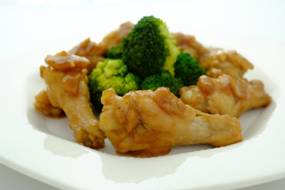
12 chicken wings, 4 tbs. soy sauce, 4 tbs. marmalade, 1 root ginger
1/2 bunch broccoli

1.Peel ginger and slice into thin strips.
2.Place chicken wings, soy sauce, marmalade, ginger strips, and 2 cups of water in a pot. Shimmer with a lid over medium heat for about 15 minutes.
3.Take off the lid, increase the heat, and cook until the juice becomes thicken.
4.Place on a plate and serve with boiled broccolis.

「Arranged Version」
~Spareribs with Orange Flavor ~
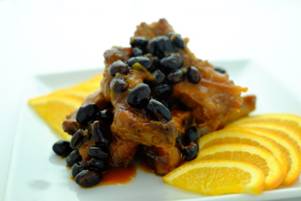
800g spareribs, 1 root ginger, 200ml orange juice, 2 tbs. marmalade, 2 tbs. tomato ketchup
2 tbs. soy sauce, 100ml water, 100g boiled black beans (sweet pot), 2 oranges

1.Peel ginger and slice into thin strips.
2.Except black beans, place all the ingredients into a pot and shimmer with a lid for 20 minutes. When juice evaporates, add some water. Add black beans and shimmer for another 10 minutes. For a finish, increase the heat and cook until the juice becomes thicken and glazed. Remove from the pot.
3.Place on a plate and garnish with an orange slice.

「Arranged Version」Teriyaki Sauce + Kiwi fruit
~Deep-fried Fish with Fresh Teriyaki Sauce ~
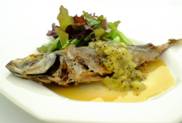
4 fish (horse mackerels in photo), a pinch of salt and pepper, 4 tbs. plain flour,
Oil for deep-frying
2 kiwi fruits, 3 tbs. soy sauce, 2 tbs. sake, 1 tbs. sugar
Several leafy vegetables

1.Remove the scales and the guts from fish and wash quickly. Dry well with paper towels. Sprinkle salt and pepper.
2.Coat fish with four lightly. Remove the extra flour.
3.Ready oil at medium temperature (appx. 170-180℃). Deep-fry the fish until it completely cooked.
4.Peel kiwi fruits and grate.
5.Pour the grated kiwi fruits in a pan with sake and sugar. When boiled, add soy sauce and stir. Remove from the heat.
6.Just before eating, spoon the sauce over the deep-fried fish. Garnish with leafy vegetables.

~Whitefish (Octopus) Carpaccio ~
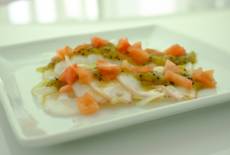
300g sashimi whitefish or octopus (octopus in photo), 1 onion, 1 tomato, 2 kiwi fruits
3 tbs. soy sauce, 2 tbs. sake, 1/2 tbs. sugar

1.Slice whitefish (octopus) thinly. Slice onion thinly as well, soak in water for 10 minutes, and drain. Peel tomato, remove the seeds, and dice. Peel kiwi fruits and grate.
2.Pour the grated kiwi fruits in a pan with sake and sugar. When boiled, add soy sauce and stir. Remove from the heat to cool down.
3.Spread the onion slice on a plate, layer the whitefish and diced tomatoes on, and spoon the sauce over it.

[ SWEETS・SNACKS ]
~ Mitarashi dango (Dumplings coated with a soy sauce-and-sugar syrup) ~
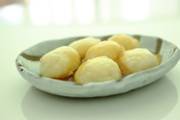
200g rice flour for dumplings (shiratamako), 200g silk tofu (or 170cc water)
2 tbs. soy sauce, 2 tbs. sugar, 1 tsp. starch

1.Add tofu (or water) to rice flour little by little and knead until evenly combined.
2.Shape the dumpling dough ① into small balls.
3.Boil the dumpling in hot water for about 3 minutes. Take them out in water and drain.
4.Pour in soy sauce, sugar, 100cc water in a sauce pan. When boiled, add starch water (dissolved in 1 tablespoon of water), and stir well. When boiled again, remove from the heat.
5.Spoon the sauce over dumplings.

~ Gohei mochi (Rice cake) ~
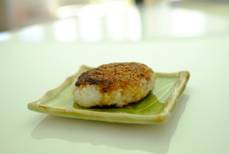
4 serves steamed rice, 2 tbs. soy sauce, 2 tbs. sugar, 2 tbs. ground sesame seeds

1.Mix soy sauce, sugar, and ground sesame seeds well.
2.Mash steamed rice lightly with a masher or a rice scoop while hot. Wet hands and shape mashed rice into oval.
3.Use a grill or a heated frying pan. Spread oil a little and cook the shaped mashed rice until both sides turn brown.
4.Spread the sauce ① on all over the rice and toast.

~ Age Mochi (Deep-fried Rice cake) ~
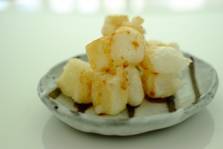
4 mochi (rice cakes), 4 tbs. soy sauce, 3 tbs. sugar, 2 tbs. water

1.Dice mochi into 2cm squares. Blend soy sauce, sugar, and water and heat up to boil.
2.Heat up oil until medium temperature. Deep-fry diced mochi until they blow up. Drain oil and place on a plate. Spoon the sauce ① over it.

TERIYAKI ②

It was Kikkoman, a Japanese soy sauce manufacturer that took an initiative in selling soy sauce in the United States in 1957. Taking advantage of it, Teriyaki sauce also started to spread throughout the United States. However, people in the United States did not know how to use soy sauce in cooking, but they were also unfamiliar with Japanese food at all. The sale of soy sauce was far from success at first. Then, one salesman who was the Japanese descendent hit upon an idea from his mother’s homemade Japanese food and came upon a good way of cooking meat dishes with soy sauce-based, Teriyaki sauce. His Teriyaki recipes were introduced in cooking classes sponsored by Kikkoman and in small handbooks for promoting sales.

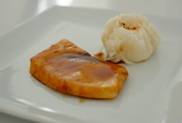
~ Teriyaki Fish Fillet ~

4 fish fillets, a pinch of salt, oil as needed, 2 tbs. soy sauce, 2 tbs. sake, 1 tbs. sugar
4 turnips, a pinch of salt, 2 tbs. vinegar, 1 tbs. sugar

1.Sprinkle salt over fish fillets lightly and leave for 10 minutes. Dry the fillets with paper towel.
2.Spread oil on a heated frying pan, place ① and cook both sides until brown.
3.Mix soy sauce, sake, and sugar well and pour into a pan. Flip the fillets occasionally and cook until juice becomes thicken and glazed.
4.Peel turnips. Leaving 5mm of the bottom, slice finely vertically first and horizontally. Sprinkle salt and leave for a while. When the whole becomes soft, squeeze to drain and pour vinegar and sugar mixture over it.
5.Place the fish fillets and turnip pickles.

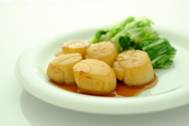
~ Teriyaki Scallop ~

12 scallop adductors, oil as needed, 2 tbs. soy sauce, 2 tbs. sake, 1 tbs. sugar
1/2 bunch mizuna

1.Spread oil lightly on a heated frying pan. Place scallop adductors and cook both sides. Pour in seasonings and cook until glazed over low heat.
2.Place on a plate and garnish with boiled mizuna.

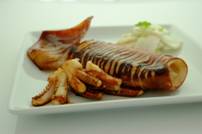
~ Teriyaki Squid ~

2 cuttlefish, 2 tbs. soy sauce, 2 tbs. sake, 1 tbs. sugar

1.Pull out the guts from the squid body and cut off above the eyes. Check the center of the tentacles for the hard beak and discard. Cut off the thin edge of the tentacles.
2.Make a shallow cut by 1cm wide on the squid body.
3.Heat oil in a frying pan and stir-fry the squid until both sides become brown. When cooked, pour in reserved mixture of seasonings, soy sauce, sake, and sugar. Turn off the heat when the squid is coated overall with the sauce.

Gradually, Teriyaki became accepted into American eating style and it has established its status as it is now. In recent days, soy sauce consumed in the United States is mostly used for making Teriyaki recipes.

Teriyaki is now widely well-known all over the world. But while Japanese Teriyaki dishes have luster in common, what refers as TERIYAKI overseas is not quite the same; it’s usually marinated in Teriyaki sauce beforehand and broiled or the cooked dishes that has Teriyaki sauce on top.