Hydroponic Tomato Experiment⑲– The Plants Passed Their Peak of Development

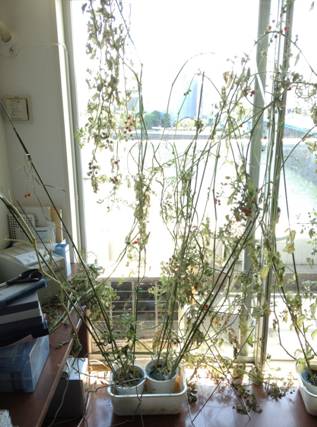
The yield of cherry tomatoes has still been increasing. However, the tomato plants growing in the heated room during winter passed their peak of development.

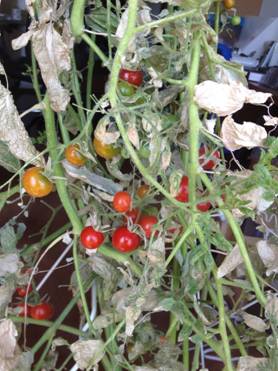
As you see in the picture above, leaves are losing color and dying though the fruits are becoming red. The spider mites have decreased, as the tomato plants still had strength. Almost all of the plants’ leaves have died, but they still had a lot of green fruit, which were turning red. What was different than before was that the color of the tomatoes looked darker. The fruit have been growing.

Overall, it is obvious that the plants got skinnier. They absorbed water slowly. Actually, it looked as if they hadn’t absorbed water at all.

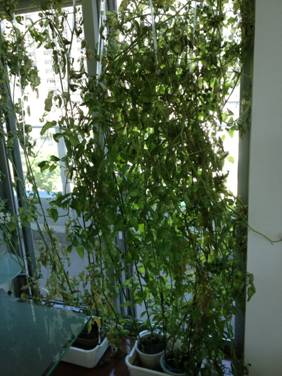
By contrast, the tomato plants in the picture above were still vigorous. They grew over the same period as the plants in the previous picture, but these plants grew in the unheated room during the cold season. They have grown slowly, but looked strong and are colored rich green, as you can see.

Hydroponic Tomato Experiment⑱– Tomato Plants After Consecutive Holidays

The first half of the Golden Week holiday was over. I was concerned about the tomato plants because during that time I hadn’t taken care of them. Take a look at the cherry tomatoes I harvested that day.

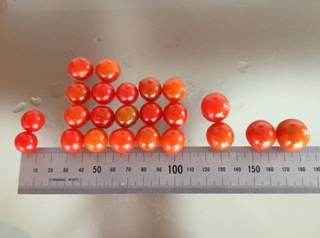
The tomatoes in the photo above were harvested on April 30, 2013. Compared to the last harvest, I thought the number of tomatoes had decreased. Actually, I harvested more tomatoes than shown in the picture above and when tallied, I had more tomatoes than in the previous harvest. The reasons I thought I had fewer tomatoes than before are as follows:

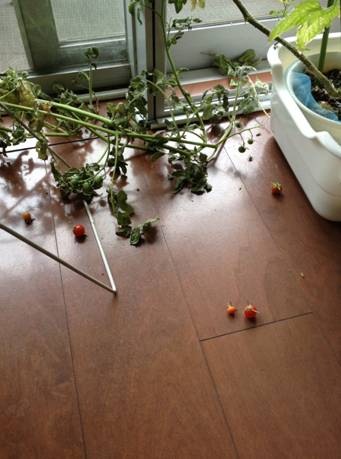
First, parts of the tomato plants fell on the floor during the long weekend. These were grown in the heated room during winter. It is possible that the tomatoes were too heavy for the branches to support because the plants passed the peak of their growth. Though the plants completed their growth cycle they still had lots of green fruit.

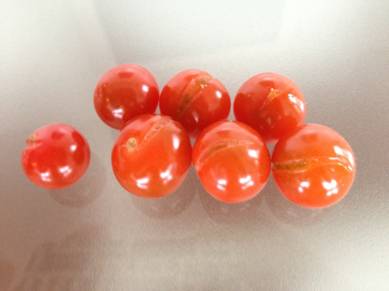
Second, many tomatoes were ruptured; they should have been picked much earlier. The ruptured tomatoes are shown in the picture above.

Third, some tomatoes were damaged by spider mites. Since growing tomatoes with minimal care is the basic idea of this experiment, I have done my best to avoid exterminating the mites. However, due to their robust reproduction, the mites have voraciously eaten at leaves and fruit of the tomato plants. Therefore, I have taken measures to eliminate spider mites such as removing damaged leaves from some tomato plants and watering the leaves and fruit to which the mites were attached.

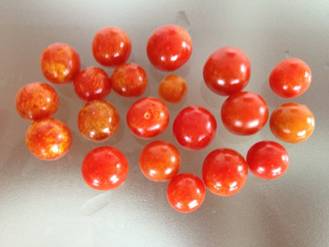
The cherry tomatoes in the picture above were grown without preventative measure against pests. The tomatoes with visible yellow patterns are the pest-infested ones. I was not able to find a good way to eliminate pests such as spider mites without using pesticides. I didn’t want to use chemicals on plants growing indoors.

For these reasons, the harvest of cherry tomatoes in good shape was small, though the total number of fruit I got was greater than the previous harvest.

Hydroponic Tomato Experiment⑰ – Spring Harvest 2013

When the weather warmed in April, the tomato plants were growing rapidly. The plants bore fruit from one to the next and many tomatoes were harvested at the end of April. Today I will show you how those tomatoes were harvested.

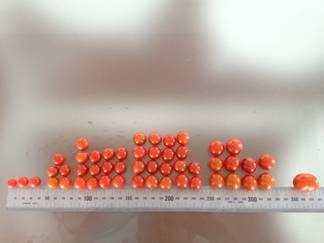
The cherry tomatoes in the photo above were harvested on April 22, 2013. By that time, I had harvested tomatoes almost every day but they were few in number. From this day on, many more tomatoes were harvested so I think it is worth reporting.

Generally speaking, they were a size smaller than those available commercially. Occasionally, I harvested larger ones but not often. It is possible that the plants I grow are simply a smaller variety of tomatoes than those sold in the markets. When I tasted these tomatoes I thought they were less sour than before. They were juicy and good.

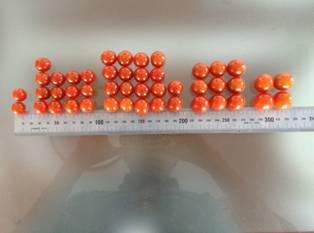
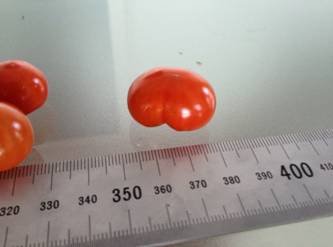
The cherry tomatoes in the above picture were harvested on April 26, 2013. On that day, a total of 50 tomatoes were harvested. When compared to those harvested on April 22, these were slightly larger in general but otherwise, no particular difference was noticeable. The one on the extreme right in the above picture showed an anomaly where two tomatoes were combined into one during development. This was the first time in my experience of growing cherry tomatoes that I got such a unique one.

Apparently, the harvested tomatoes haven’t reached their peak yield yet. I expect more and more tomatoes will be harvested.

Mystery of Better Nourishment by Sunlight – Japanese Dried Foods Part V

So far, we have studied Japanese dried foods from various perspectives including history, associated traditions, and food characteristics. In this blog, let’s study the nutritional differences between fresh and dried forms of some food items.

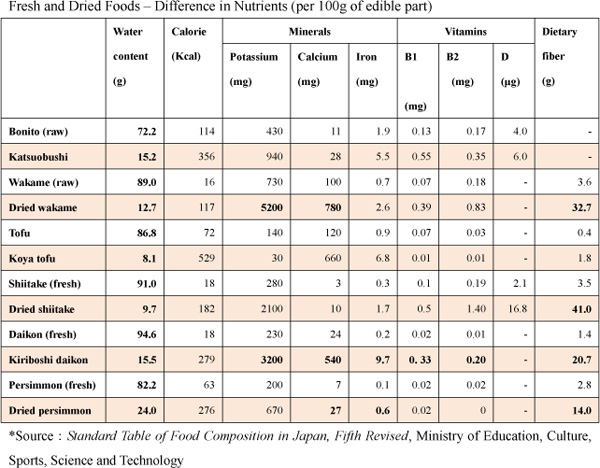
What is the difference between fresh and dried foods? Dried foods are made by exposure to the sun, so obviously they contain less water than fresh foods. Due to the lower water content, nutrients are more highly concentrated; when comparing both, per 100 grams of product weight, dried foods supposedly contain more energy, protein, minerals, etc. than fresh foods. Well, then, is the difference between fresh and dried foods just water content?

The above table is a nutritional comparison between fresh and dried foods. You can see that each pair of fresh and dried items contains different amounts of water, and there are differences in the nutritional values of dried foods that are not simply because of lower water content. Take a look at the values in bold type. For instance, look at the wakame row. Dried wakame has more potassium and calcium, and far more dietary fiber than raw wakame, whose difference in value is greater than the difference in water content. Further, when comparing fresh and kiriboshi daikon, dried daikon contains far greater amounts of minerals, vitamins, and dietary fiber than the fresh daikon even when taking differences in water content into account. Dried persimmons, which are too astringent to eat in their fresh form, become a sweet, delicious, and healthy food containing lots of minerals and dietary fiber after drying.

Though not shown in the table, dried foods obviously contain more umami elements like amino acids and nucleic acids. For example, Katsuobushi contains lots of inocinic acid, which is known as an umami element but which doesn’t exist in living bonito. When bonito die, inocinic acid is synthesized by the effect of the enzyme in its muscles. Drying and processing bonito at the right time gives katsuobushi its rich inocinic acid content.

In oriental medicine, foods are categorized into “yin” (which decreases body heat) and “yang” (which increases body heat) types and advise maintaining healthy by eating the appropriate yin and yang foods. Dried foods, which have been fully exposed to the sun have mostly “yang” or “medium” properties, which means that they improve your metabolism and help boost the immune system. While it has been said that “colds may lead to all kinds of diseases,” yang foods are said to be effective in preventing colds and cancer.

Long ago, when people didn’t have means of preserving raw foods like today’s freezing and refrigeration technologies, they showed wisdom and used the natural energy of sunlight on dry foods so they were able to preserve foodstuff for sustaining themselves in times of food shortage. And now, these dried foods, a product of our ancestors’ wisdom, provide modern people with something much more valuable than just preserved foods.

As we have seen, dried foods are not simply products from which water has been removed but also products containing lots of nutrients and umami elements. We hope that you will pursue your interest in dried foods – which contain a lot of natural energy, are healthy, safe, and delicious foodstuff – and use them in your everyday diet.

Reported by Yukari Aoike, Sugahara Institute

Local Specialties and Delicacies – Japanese Dried Foods Part IV

You know that one of the most popular foods in the world is noodles. In the West, there are different kinds of long pasta originating in Italy and in Asia; a variety of noodles from China are consumed. The Japanese are world-class noodle eaters. They like both Italian pasta and Chinese noodles – spaghetti and ramen dishes have been very popular in recent years – and they have loved traditional Japanese noodles like soba (buckwheat noodles) and udon (wheat-flour noodles) since the Edo period. Restaurants do cook and serve fresh soba and udon noodles but most people cook dried noodles at home.
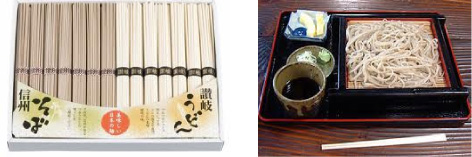
The original forms of soba and udon have existed since the Nara period, but lay people started eating them as noodles after the Edo period. In the city of Edo, soba and udon were available at street stands like today’s fast food. At the street stands, they served boiled noodles with “mentsuyu” consisting of “dashi soup” from katsuobushi and kombu, and “kaeshi” made from soy source, mirin (a kind of rice wine) and sugar.

Now soba and udon are found all over Japan but generally, people in the eastern part of Japan tend to love soba, while those in the western part love udon. Soba is a specialty product of several prefectures including Nagano (Shinshu soba), Iwate (wanko soba), and Niigata (hegi soba) while udon is a specialty of such prefectures as Kagawa (Sanuki udon), Akita (Inaniwa udon), and Aichi (kishimen). The soba and udon in these highly regarded areas are extraordinary good and these specialty noodles are a major attraction for tourism.
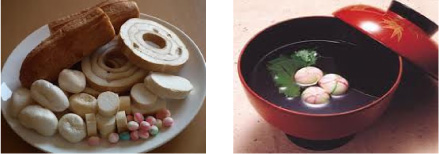
Like soba and udon, fu is also a dried grain product. Fu is made from wheat gluten, flour, and baking power by baking or frying. There is a wide variety of fu from tiny and pretty temari fu, which is often used as garnish for traditional soup, to kuruma fu, which is shaped like wheels, and age fu that looks like fried buns. Fu was introduced from China around the 14th century. Since the product contains lots of gluten, it was adopted for shojin ryori at temples as a source of protein for monks who were prohibited from having meat or fish with meals.

Fu is a specialty product of the following prefectures: Yamagata (ita fu), Niigata (kuruma fu), Miyagi (abura fu), etc., and is used for cooked, fried and soupy dishes. The product itself has no taste but when cooked it tastes good since it absorbs the juices and seasonings of other ingredients; in addition, it is a healthy product high in protein.
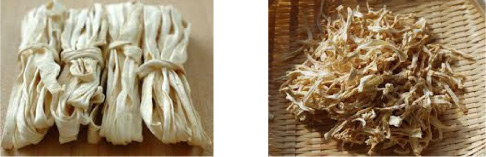
The products in the photos above are both dried vegetables. Shown at left are kanpyo, dried shavings of gourd. Kanpyo is high in dietary fiber and minerals but is low in calories. It used to be a major ingredient of sushi; when you asked for “nori maki” at sushi restaurants it meant you ordered the sushi roll with kanpyo. Now the roll is called “kanpyo maki.” The sweet and crunchy texture of cooked kanpyo goes well with sushi rice and is an essential ingredient in chirashizushi. In the Edo period, a feudal lord who moved from Osaka to Tochigi promoted the cultivation of gourd. Since then, kanpyo has been a specialty of the Tochigi prefecture, which provides 80% of total production in Japan.

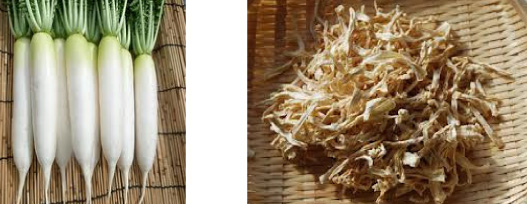
The product in the above right picture is kiriboshi daikon. It is made by shredding then sun-drying daikon radishes. After softening the daikon by soaking it in water, it is usually cooked with vegetables and aburaage and served. Kiriboshi daikon is a specialty product of the Miyazaki prefecture, which produces 90% of national production since Miyazaki is a major daikon-producing region and in winter, the cold winds blow from the mountains and effectively dry the shredded daikon.

Through these means, these dried foods contain a lot of sun light, and nutrients concentrated by drying which are, so to speak, natural supplements. Beyond those mentioned in our blogs, Japan has many other dried foods. They are traditional foods processed by methods adhering to ancient wisdom. Although they appear unassuming, they contain lots of umami, dietary fiber, and minerals, yet not many calories. Therefore, if you are concerned about stress, weight gain, or adult diseases we recommend you use these dried products for your diet.

Reported by Yukari Aoike, Sugahara Institute