
The first half of the Golden Week holiday was over. I was concerned about the tomato plants because during that time I hadn’t taken care of them. Take a look at the cherry tomatoes I harvested that day.
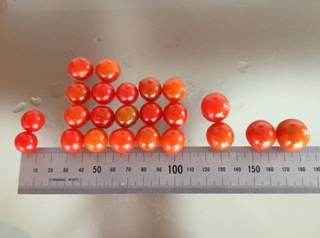
The tomatoes in the photo above were harvested on April 30, 2013. Compared to the last harvest, I thought the number of tomatoes had decreased. Actually, I harvested more tomatoes than shown in the picture above and when tallied, I had more tomatoes than in the previous harvest. The reasons I thought I had fewer tomatoes than before are as follows:
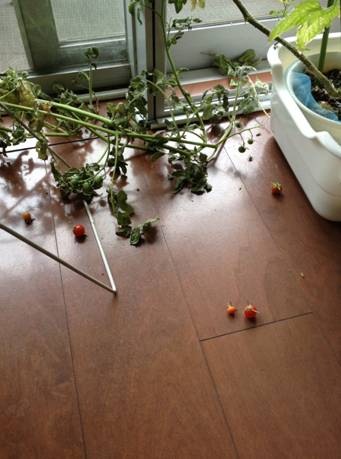
First, parts of the tomato plants fell on the floor during the long weekend. These were grown in the heated room during winter. It is possible that the tomatoes were too heavy for the branches to support because the plants passed the peak of their growth. Though the plants completed their growth cycle they still had lots of green fruit.
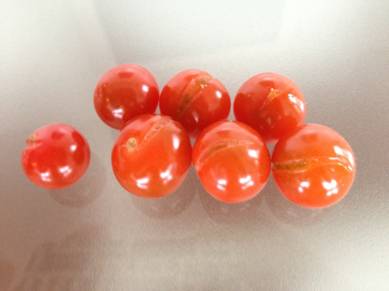
Second, many tomatoes were ruptured; they should have been picked much earlier. The ruptured tomatoes are shown in the picture above.
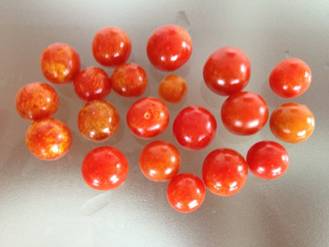
Third, some tomatoes were damaged by spider mites. Since growing tomatoes with minimal care is the basic idea of this experiment, I have done my best to avoid exterminating the mites. However, due to their robust reproduction, the mites have voraciously eaten at leaves and fruit of the tomato plants. Therefore, I have taken measures to eliminate spider mites such as removing damaged leaves from some tomato plants and watering the leaves and fruit to which the mites were attached.
The cherry tomatoes in the picture above were grown without preventative measure against pests. The tomatoes with visible yellow patterns are the pest-infested ones. I was not able to find a good way to eliminate pests such as spider mites without using pesticides. I didn’t want to use chemicals on plants growing indoors.
For these reasons, the harvest of cherry tomatoes in good shape was small, though the total number of fruit I got was greater than the previous harvest.