Happy New Year 2013!
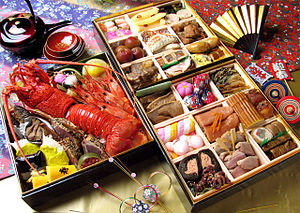
A New Year is the most biggest and important event of the year for the Japanese. Most people take consecutive days off between the end of December and the first 3 days of January to go back their hometown and have a New Year with their family. On such a special occasion, we prepare a special traditional Japanese food for a New Year’s Day, called Osechi. For the same purpose, we also eat Ozoni.
It is said that Ozoni was made by the withdrawn offerings which the family had offered to the household alter upon welcoming a New Year. So having Ozoni means to thank for the harvest and the peace of the previous year and to wish for the coming year.
Generally, well-known Ozoni is a clear, soy sauce-based soup with boiled vegetables such as white radish, carrot, shiitake mushroom, or spinach along with boiled shrimp with its head, and a piece of chicken. And most importantly, Ozoni has a toasted rice cake (mochi) in it. Ozoni is a good example of the Japanese traditional food that shows each regionality by its ingredients and the soup type. The soup type of Ozoni that most eaten in Kanto area, the eastern Japan, is clear type whereas that of Kansai area, western Japan is white miso (soy bean paste) soup. The shape of a rice cake can also be peculiar to the region, whether it should be round or square and whether it should be toasted before added to the soup or not. When newly married couples have a New Year for the first time, they may encounter a situation that their partner eats different type of Ozoni.
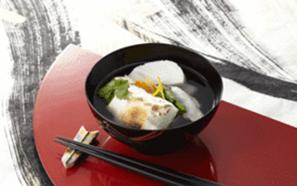
Ozoni, Kanto-style (CITED: AJINOMOTO PARK http://park.ajinomoto.co.jp/)
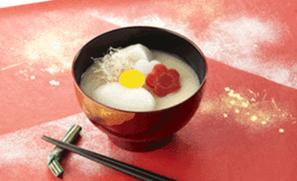
Ozoni, Kansai-style (CITED: AJINOMOTO PARK http://park.ajinomoto.co.jp/)
A friend of mine who is from Okinawa told me that a typical Ozoni has been rooted in her hometown these days, but it is still a tradition in Okinawa to eat an Okinawan traditional festival foods like Nakamijiru (clear soup with boiled pork offal) or Inamuduchi (white miso soup with boiled pork and vegetables). Some people like to add a toasted rice cake in it on New Year’s Day for special. My friend’s husband is from mainland Japan so she found it a kind of culture shock to know that he has a different way of spending New Year’s Day including how to make the special New Year’s Day meals. But now she has adapted a tradition of her husband’s home.
It is often said that Japan is full of Western culture and people tend to make light of Japanese culture and they are reluctant pass it down to the next generations. But I can tell how important the New Year’s Day is to the Japanese because people, even the young, still follow a tradition to get together with family on New Year’s Day and eat same old traditional foods every year.
Written by
Akiko Sugahara, Tomomi Tanaka



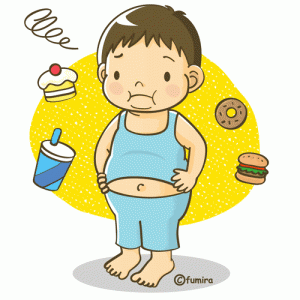 In the US, 50% of children are considered to be obese whereas that of Japan is 8% on the average. The highest is 13% and it is recorded in remote rural areas. Those percentages show that we don’t have as many obese children as in US. But considering the fact that the number of obese children (boys) in Japan over the last 20 years has increased from 6% to 12%, I cannot deny that there is a significant change in our diet. We are likely to eat more and more western-style foods, and at the same time, more and more people tend not to eat full meals in the morning. Fortunately, there seems to be a trend that the number of obese children has been decreasing since 2006. I feel so pleased to know it.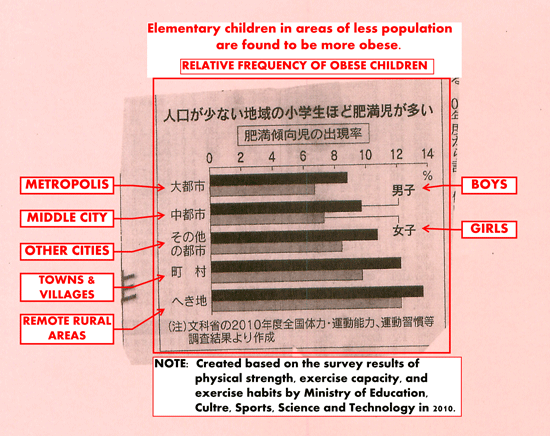
 If the income level continues to show a tendency to decline year after year, both parents may have to work longer. I can imagine that the delivered pizza, snacks, games may be all over the house when mothers come home exhausted form work. In order to restore the small rural areas where children can play around energetically, we, the adults are in great demand to think more critically and act accordingly.