What Did the Best Flavor Taste Like? – Japan’s Oldest Dairy Product

“The best part of traveling is the moment when you unexpectedly come across something interesting.” When we say the above in Japanese, we often use the word “daigo-mi” to describe “the best part.” Daigo-mi literally means “taste of daigo,” but we don’t know what daigo tastes like and we wonder how it tastes.

I checked the origin of the word daigo, and found that the word was mentioned in a Buddhist scripture called the Nirvana Sutra. According to the sutra, The Nirvana Sutra is the best of all the Buddhist texts just as “daigo” is the best of all the five flavors (gomi) in the processing of dairy products.
Regarding gomi (the five flavors), the sutra mentions that milk is processed like this:
nyu (milk) –> raku –> sei-so –> juku-so –> daigo
Therefore the last one, daigo, was supposed to be the best flavor, equivalent to the best Buddhist sutra and the highest-quality product made from milk.
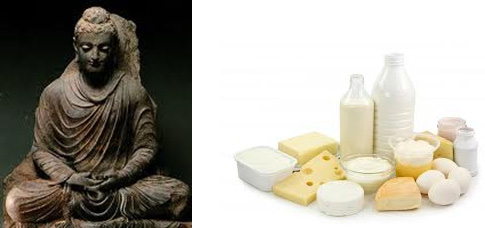
Buddhism and dairy! What a surprising combination. Even more surprisingly, dairy products existed when Buddhism came to Japan from India through China and Korean peninsula. Was daigo something like butter, or more like cheese?
Buddhism was introduced to Japan about 1,500 years ago. On the other hand, milk products became popular among Japanese people after World War II. In the meantime, I don’t think the average person in Japan had ever tasted milk or cheese. If so, daigo may have been Japan’s oldest cheese.

By the way, when and how was cheese first made?
Cheese is made when you curdle milk in some way or another, solidifying it by draining the water. There are several theories about the origin of cheese and it is unknown which one is accurate, but it is said that cheese was first introduced to the world about 6,000 years ago.

Among dairy products, there are so many kinds of cheese made of different ingredients and by different processes. Like bread and wine, cheese was first made by chance, but there are three main cheese-making processes. These are to: 1) curdle milk by adding rennet, which contains enzymes; 2) curdle milk by adding an acid such as vinegar; and 3) simmer milk until it becomes solid.
Various kinds of cheese we have today originated in Europe, and most of them are manufactured by method no.1 (enzyme coagulation).

Well, how was daigo made?
According to the Nirvana Sutra, daigo was so delicious, and cured all sorts of diseases. In the Asuka period, a culture of milk products was introduced along with Buddhism. Regarding so, one of the introduced dairy products, whose quality level was just below daigo, the processing formula and the historical record that show it was used for a tribute to Emperors were found in Japan’s ancient documents such as Engishiki. So was a very rare and valuable processed food providing good nutrition that only people of the noble class were able to enjoy.

So was made by the abovementioned method no. 3 – simmering cow milk – until it became solid and matured. This is probably Japan’s oldest milk-based processed food. However, there’s no record mentioning that daigo was produced in Japan. Eventually daigo was not available in Japan. Later, the culture of eating milk products in ancient Japan passed away as aristocratic society came to an end.

So, I was not able to taste daigo. However, you can taste so instead of daigo! A dairy farm at the south foot of Mt. Kaguyama, Nara pref., where the capital of the Asuka period was located nearby, succeeded in producing so based on the ancient recipe and put it on the market under the trade name “Asuka no So.” It is a natural food made only by milk, using no additives.
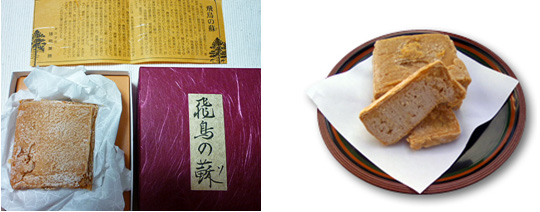
I got this so via the Internet. Asuka no So is a brownish square cake with a hard crust on the surface, obviously looking like an ancient cheese. You can taste its sweetness and rich flavor of milk. Yes, it should be cheese. This is a dairy product that only a small number of noble people were able to enjoy in the Asuka period about 1,300 years ago. Thanks to the word daigo-mi meaning “the best part,” I was able to savor the taste of the best part of Japan’s ancient past – its oldest dairy product , as revived in the present.

“Asuka no So” Milk Kobo Asuka’s website: http://www.asukamilk.com/so/index.html

Reported by Yukari Aoike, Sugahara Institute
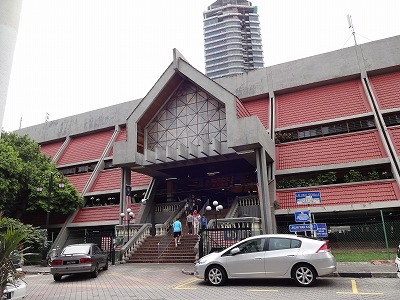
Welcome to the world of Malaysian cuisine

Japanese love Asian cuisines such as Chinese, Korean, Thai, Vietnamese, and Taiwanese cuisine. How about Malaysian cuisine? Unfortunately, it hasn’t been popular yet.
Why?
Maybe it’s because of the image of boiled fish? Is it because its color visually dark? Is it because of HALAL food for Islamist?
I have been to Malaysian restaurant in Ikebukuro named “MALAYCHAN” (http://www.malaychan-satu.jp/) when I was a university student. Malaysian dishes were too rare to try for me then, I could eat only Nasi Goreng (Malaysian fried rice).
But now, I know Malaysian food suit Japanese taste!!

There are a plenty of tasty foods in Malaysia. Malaysian food is not popular like Thai food in the world, but the great thing in a multi-ethnic, multi-cultural Malaysia is that you can eat various ethnic cuisines.

By the way, what is Malaysian cuisine?
There are 4 major cuisines, which are Malay, Malaysian Chinese, Malaysian India and Nyonya. Nyonya cuisine combines Chinese and Malay cooking techniques and ingredients and it’s started from the Straits Settlements (Penang, Malacca, Singapore). The unique thing is that pork is used for Nyonya cuisine.

Furthermore, there are many authentic ethnic restaurants. Of course, you can find a lot of Japanese restaurants! You have options to choose Ramen shop and even SUKIYA Gyudon recently came to Kuala Lumpur!!

The number of Malaysians who visit Japan is recently increasing. But Malay Islamists seem to feel difficulty to find HALAL food in Japan. I have heard from a Malay friend that there is one popular chain restaurant in Japan. Guess which chain is?
It is TENDON TENYA. Tendon is a dish cooked fish and vegetables, so they can eat Tendon in relief.
Halal food is the one allowed under Islamic dietary guidelines. Chicken and Beef are allowed, but they must be manufactured under the special HALAL process. That’s why Islamists can’t eat Gyudon or Oyako-don in Japan.

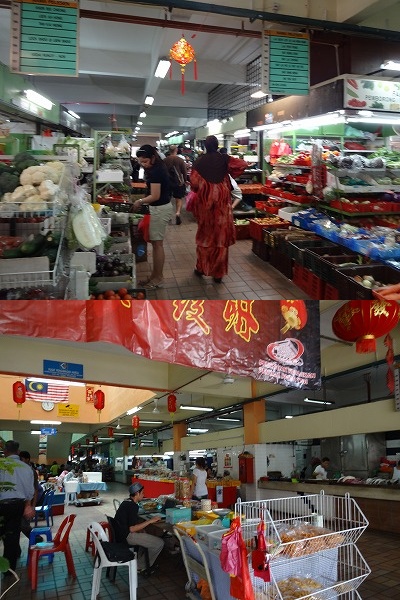
In supermarkets in Malaysia, Non HALAL foods such as pork and alcohol are sold in a separated corner. I am afraid to say, but I can’t satisfy the quality of pork sold in supermarkets.

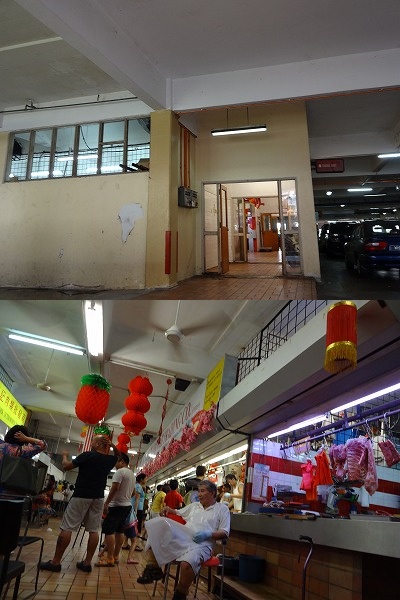
In such circumstances, there is the most famous pork shop in Japanese. The pork shop is located in KDDI market, Kuala Lumpur. KDDI market is always crowded as kitchen of local people.

No.1 pork shop in Japanese is separated from other shops and located next to car parking in the basement.

The Key points of popularity are freshness, affordable price and quality. And one more important point for Japanese is staffs meet requests of slice. We can buy slices for Shabu Shabu, belly slices, blocks for braised pork belly etc. This shop is the gathering spot for Malaysian Chinese and Japanese.

You can find fresh and affordable vegetable, fruit, fish, and meat in this market.

One of fish shops is also famous in Japanese because staff can say some kinds of fishes in Japanese and slice into fillets and debone (Sanmai Oroshi in Japanese).

Do you think it’s very simple reasons?

Yes, it’s simple. But don’t you think that it’s hidden missing business tips in this example?

Reported by Makiko Wada, Sugawara Institute

Ise Jingu, the Ancestral Kami of the Imperial Family and the Tutelary Deity of the Japanese People – part 3

Oise Mairi, the First Group Tour by Japanese Common People

When the regime changed from the Emperor to samurai in Japan, Ise Jingu was worshiped as the supreme deity. In the medieval period, however, when Japan was in the midst of endless wars, the Shikinen Sengu ceremony ceased for a while. During that time, wars resulted in damage to the Jingu site and the Jingu went through hard times both physically and economically.

Then onshi, priests who managed religious services in the Jingu, rose to take action. In order to promote visits to Ise Jingu among ordinary people including peasants, onshi traveled all over the country, distributing the useful Jingu calendar to homes and actively engaging in missionary work.
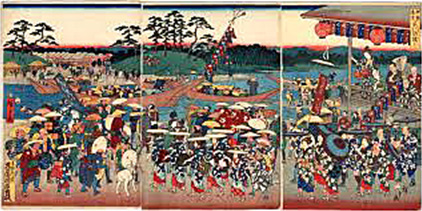
During the Edo period, when the world became stable, the transportation network including the Go-kaido, the five major highways was constructed, making traveling easier. That was when group pilgrimages to Ise Jingu gained great popularity among peasants and townspeople. People called the tour “Oise-mairi.”

Oise-mairi, a.k.a., okage-mairi was more like worshiping and sightseeing than a pilgrimage. Here, onshi did a great job – their work of distributing calendars served as a trigger to the trend of okage-mairi. Onshi played an important role in people’s travel to the Jingu not only as priests but also as Japan’s first tour conductors. In this period, one out of six people went to worship at the Jingu every year, and there’s a song with lyrics like “…I want to go to Ise even once in my entire life…”

So 5 million people, one-sixth of Japan’s total population of 30 million at the time, traveled in groups every year. If the same thing had happened in China, the tour groups would have been regarded as a religious rebellion and executed. Traveling at that time was what you did at the risk of your life anywhere in the world. Therefore, people would travel with bodyguards. Under the circumstances, it must have been a miracle that it became the norm for people in Japan to make such unconstrained, risk-free trips to the Jingu. Considering the fact that at the time doing things in groups was a security risk, we should say that the security management of the Edo Shogunate was wonderful for its generosity.

People traveled on foot from every region of the country to Ise Jingu, and it took about 15 days from the town of Edo. It was really a long trip and naturally cost a lot of money. The trip was not what ordinary people could easily afford. So they establish a reserve fund system called “Ise-ko” in each community. Each member routinely paid a certain amount of money to the travel fund through which they covered the travel expenses for the party of representative members who would go to Ise. The representatives were chosen by lottery and the winners would go to worship the Jingu on behalf of the community.

The abovementioned funding system, called ko, effectively allowed poor people to fulfill their desires without borrowing money from a bank until the Showa period. The ko system worked when there was a mutual trust between persons involved, but it wouldn’t have worked if someone got money and ran off with it. Therefore, the system worked only because of the national characteristic of keeping promises.

During the Edo period, traveling was strictly restricted among peasants and townspeople; they were not allowed to go on long-distance trips without a travel permit. However, if the purpose of their trip was to worship at the Jingu, the permit was easily acquired and they could pass through the checkpoints. Even when townspeople went on the trip without telling their parents or their master, they were not punished at all if they got home with evidence such as talismans and souvenirs which proved they worshiped the Jingu and prayed for business success. Good times, don’t you think?

During their journey to Ise Jingu, they had a really good time. They fully enjoyed the tour.
Onshi, the priests and the most powerful tour conductors, were there for them just like tour guides. The onshi took the travelers sightseeing and taught them how to worship at the Jingu. The travelers were able to taste good sake and enjoyed feasts fit for a king, sleep on a soft futon, and have a great trip that was literally an once-in-a-lifetime experience. Of course onshi themselves gained a lot from the tours.
Thus, in the Edo period the Ise Jingu thrived.

As you can see, the lifestyle of Japanese people in the Edo period seemed loose and pleasant, and somewhat adventurous. According to records, women enjoyed the trip just as men did, so the status of women at the time may have been better than in the Meiji period. For those who lived on the road it was only natural to support travelers. It was common for the locals to provide travelers with a place to rest, as well as benches, tea, and sweets. Even today, there are many people who voluntarily support travelers. Like the phrase okage sama de, which means “thanks to you,” everyone in the Edo period knew that charity is an investment; if someone traveled and spent money, the money also traveled and turned the economy upward. We think this outlook shows that they valued a tenderhearted, win-win relationship beyond their ecological living.

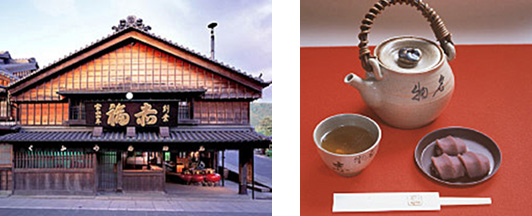
There is a shopping street called Okage Yokocho near Naiku of the Jingu. There are many restaurants and souvenir shops in the street, attractions for those who visit the Jingu.
Especially when we hear the words Ise Jingu, they remind us of a Japanese sweet cake, Akafuku. Akafuku is famous and sold nationwide but tasting Akafuku at the original store is especially good.
When you visit and worship the Jingu, we recommend that you come to Okage Yokocho.

Okage Yokocho (Mie Tourism Guide): http://tourismmiejapan.com/search/spot.php?act=dtl&id=36

Reported by Yukari Aoike and Akiko Sugahara, Sugahara Institute

Ise Jingu, the Ancestral Kami of the Imperial Family and the Tutelary Deity of the Japanese People – part 2

The real reason for conducting such a huge reconstruction every 20 years is unknown, but there could possibly be the following:
- Since the buildings have been built in a style following the ancient arrangement of 1,300 years ago, pillars and other parts tend to deteriorate quickly and need to be replaced.
- While the Kanname-sai ceremony, which is conducted to pray for good harvests, is an annual ceremony in the Ise Jingu, Shikinen Sengu culminates the annual event as a larger edition of the ceremony.
- For generational transition where old carpenters pass construction methods on to their successors.

Who on earth found a way to repeat reconstructions so money-consuming and so ineffective? That is really strange. Who has been covering the cost throughout history?
Unlike Roman Catholicism, the Japanese Emperors have always been positioned as national symbols except during the particular period (from the Meiji period to prior to World War II) in which they had their own property. So generally they didn’t cover the cost for Shikinen Sengu ceremony. It was the powers-that-be and wealthy merchants who covered the cost. Now is the time when we find most difficult to ask for donations from the public, and that is a dilemma
More than half of Japanese people have little interest in knowing about their own country and don’t even know what Sengu is.

This year Ise Jingu, where the Shikinen Sengu ceremony is being held, is the place worth visiting. Especially during summer and autumn months, there will be various ceremonies held related to the Sengu, and you will be able to see a large number of worshippers visit the shrine.
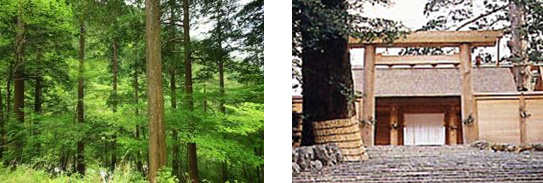
Since 10,000 hinoki (Japanese cypress) logs are used for the Sengu reconstruction, the Jingu is supposed to be infused with the fragrance of cypress.
Why not visit the Ise Jingu, the guardian deity of Japanese people, as it is lovingly reconstructed? The cypress fragrance that fills the air creates an atmosphere of solemnity.

Indeed, preserving the creation over the past 1,300 years is a miracle of history. Traditional technologies have been handed down from person to person. It is as if there existed a time capsule that to tell Japan’s future generations how people in the past were so ecologically minded. You could say the time capsule waits with bated breath for a time when we have the scientific capability to figure out the details of their ecological lifestyles.

Regarding the hinoki cypress required for the Shikinen Sengu ceremony; so far, the timber has been collected from forests all over Japan. However, Mr. Tsuneyasu Takeda mentions that there is a project for reforestation of the Jingu’s sanctuary forest, which will provide all the whole timber required for the Sengu a few hundred years from now. The story makes us happy and dizzy at the same time. That’s the very reason for the Shikinen Sengu ceremony. Ecological living is about making sustainable systems responsible for the next few hundred years. The Sengu reconstruction doesn’t produce waste; the old lumber used for the current Jingu will be shared with subsidiary shrines all over Japan where they use the materials for torii and more. The secret of Ise Jingu is filled with unknown profiles which attract those who are charmed by the shrine, but whether you open the door or not is up to you.

Ise Jingu Official Website: http://www.isejingu.or.jp/shosai/english/index.htm

Reported by Yukari Aoike and Akiko Sugahara, Sugahara Institute

Ise Jingu, the Ancestral Kami of the Imperial Family and the Tutelary Deity of the Japanese People – part 1

According to certain statistics, the total number of Shinto and Buddhism believers in Japan is about twice that of the country’s total population. Are the statistics wrong? No, no. The statistics mean that many Japanese people really believe in both Shinto and Buddhism. From other nationals’ perspectives, we appear to have strange religious views.

In Japan, when babies are born, parents take them to the local shrine. At the festival, people carry mikoshi (a portable version) of their local shrine. We exchange wedding vows in front of a shrine. Shinto-style weddings started in the Meiji period, and the majority of Japanese couples made vows in the Shinto style until the 90’s. However, it is believed when people die, they become Buddha and are buried in Buddhist cemeteries or temples. Therefore, in most cases funerals and memorial services are held in temples, not shrines. This system is quite natural to Japanese people, who take to it as everyday Japanese custom from the time that they are born. In this way, Japanese people are profoundly connected to kami and hotoke, shrines and temples, in various aspects of their lives, including ceremonial occasions.

Japanese people tend to be in awe of the nature, the surrounding environment, and spiritual things that they can’t see. We believe kami are the spiritual beings everywhere in the universe, and are always with us. Yaoyorozu no kami, which means “eight million gods,” are what we worship. Such belief has to do with a social structure in which the Japanese have lived as rice cultivating communities since ancient times. Maybe we have disciplined ourselves by worshiping nature and spiritual beings.

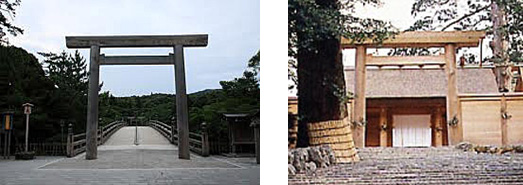
There are about 80,000 shrines in Japan. Among them is Ise Jingu in which Amaterasu Omikami, the ancestral kami of the Imperial Family and the tutelary deity of the Japanese people, is enshrined, and it is the most important shrine representing Japan. The shrine was constructed as Jingu, a prestigious shrine, about 1,300 years ago during the Aska period. The whole of Jingu covers an area of 5,500 hectares (ca. 13,600 acres).

Above all, the religious institution has kept its sacredness and has been protected by the powers of the day for 1,300 years without being attacked, burnt, or disgraced. It can only be called a miracle by historians or foreigners that the institution, a small and simple wooden house, has existed over the long history of Japan. In other words, Japanese people who believed the Jingu would be there forever should be the ones who lived in a paradise on earth, totally free from the history of killings and destruction the world has experienced. We lived in such a peaceful world even taking into account the distressing experience we had during World War II.

At Ise Jingu, there is a major event which has been ongoing since the Jingu was constructed. It is called Shikinen Sengu ceremony, a big festival held every 20 years. Shikinen Sengu is a large-scale and important event where all the buildings in the sanctuary, including the main buildings of the Jingu, treasure houses, fences and torii are reconstructed and relocated once every twenty years and the sacred apparel and treasures are renewed and carried to the new buildings. 2013 marks the 62nd Shikinen Sengu ceremony which will be held in October. Preparations for the big festival started eight years ago and the total cost will be 55 billion yen. Wow!

After World War II, State Shinto came to an end, and since then only a part of national taxes has been invested in the cost for Shikinen Sengu ceremony. Surprisingly, public donations cover most of the cost. Mr. Tsuneyasu Takeda, a lecturer at Keio University, who comes from the Meiji Emperor’s bloodline, has been making all-out efforts to ask for donations by holding free lectures all over Japan around 300 times a year.

Ise Jingu Official Website: http://www.isejingu.or.jp/shosai/english/index.htm

Reported by Yukari Aoike and Akiko Sugahara, Sugahara Institute

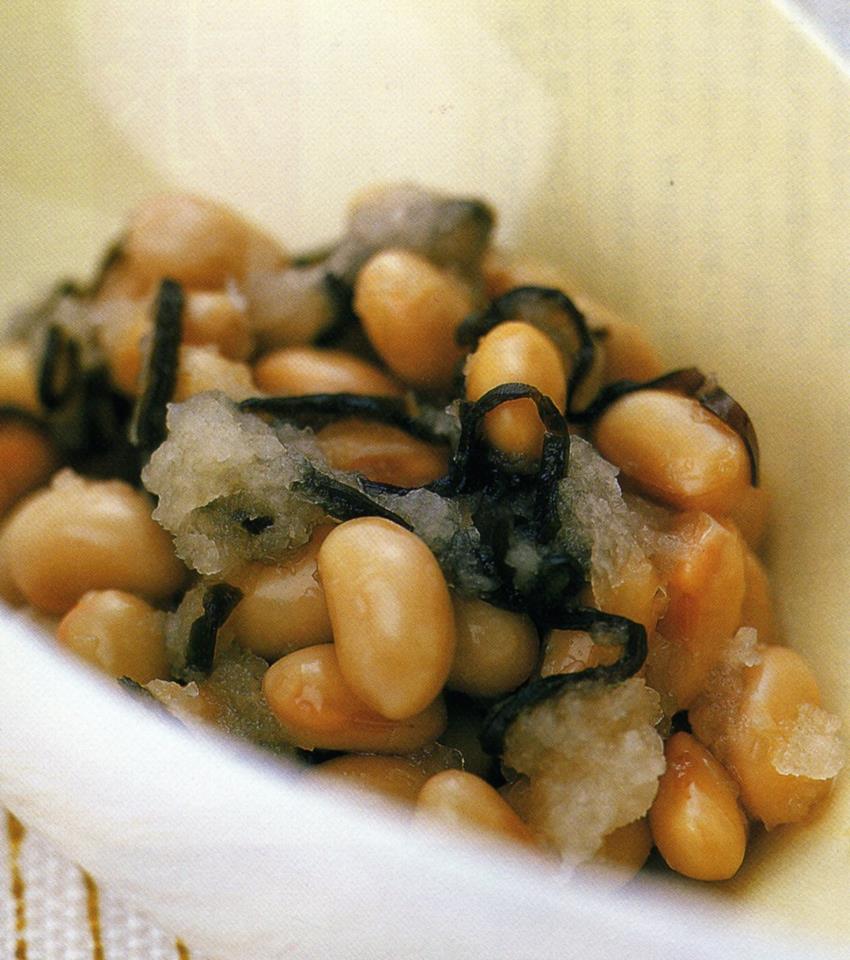
Soybean in ground radish

Soybean in ground radish (94 kcal)

Soybeans: Soybean isoflavone for relief from menopausal disorders

Soybeans contain cholesterol-reducing saponin, aging-retarding vitamin E, B-group vitamins for improving your skin and calcium. However, it is their isoflavone, whose molecular structure resembles that of the female hormone oestrogen, which is particularly effective against menopausal disorders. Being a vegetable substance, isoflavone treats symptoms gently, and because it stops calcium from dissolving out of the bones, it can also prevent osteoporosis.

Ingredients for 2 servings: 100 grams steamed soybeans 5 cm Japanese radish 1 teaspoon salted kelp Preparation: 1. Peel then grate the radish. 2. Lightly wring the grated radish then mix it with the steamed soybeans and salted kelp.